
Trading down to a smaller vehicle is often framed as a compromise. Let's go through how to do it without regrets. For many South African motorists in 2026, it's actually a strategic upgrade. Moving from a premium sedan to a compact hatchback or a mid-sized SUV doesn't mean settling for less. It means putting your money towards financial stability and practical utility without giving up quality. The trick is telling the difference between features you genuinely use every day and badges that only signal status to strangers.
We've built our business on one idea: if a vehicle isn't good enough for our family, it isn't good enough for yours. That applies just as much to affordable compacts as it does to luxury bakkies, because your safety and peace of mind shouldn't be casualties of a budget adjustment. Downsizing well takes honest self-assessment, and a dealer who values long-term trust over a quick sale.
Why South African Buyers Are Trading Down in 2026
Economic pressure has changed how established professionals approach vehicle ownership this year. Buyers are increasingly moving to smaller, cheaper cars as a strategic response to current conditions, not because they're settling for inferior transport. It's a rational recalibration of household budgets, where mobility stays essential but excess capacity becomes a cost you can't justify.
The Shift From Premium to Practical Models
You might assume stepping down a segment means accepting more risk or lower build quality, but modern manufacturing has largely closed that gap. Many compact models now offer safety ratings, infotainment and refinement that rival executive cars from just five years ago. The real difference shows up in running costs and depreciation, and both favour the buyer who chooses practicality over prestige.
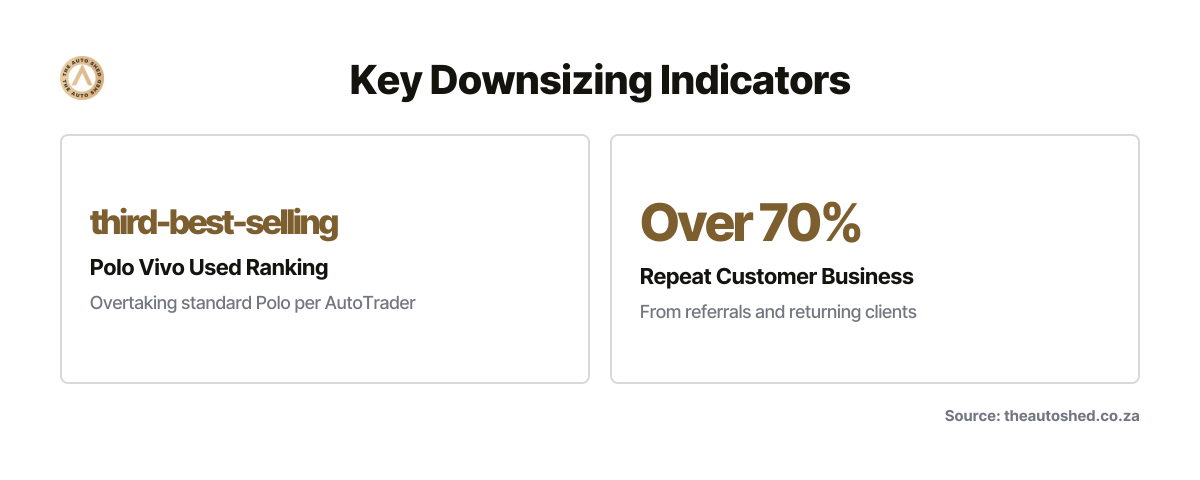
This shows up most clearly among repeat customers who previously owned premium German sedans and now want reliable Japanese or Korean alternatives instead. They still want excellence. They just want to shed the steep maintenance premiums that come with complex luxury engineering. Over 70% of our business comes from repeat customers and referrals who trust our hand-selected inventory and strict inspection standards, across every price point we sell.
Market Signals: Polo Vivo Overtaking the Standard Polo
AutoTrader’s September 2026 data shows the Polo Vivo overtaking the standard Polo as the third-best-selling used model in South Africa, behind only the Ford Ranger and Toyota Hilux. It’s a telling sign of where buyers are putting their money. It confirms buyers are actively prioritising proven reliability and low running costs over newer technology or brand cachet. The Vivo's dominance shows the market has moved past simple badge loyalty towards total lifecycle affordability.
These trends back up trading down as a mainstream financial strategy, not a distress purchase. When the broader market leans toward value-oriented models, resale liquidity improves for those vehicles too. You get to enter a segment where demand is strong and supply has been vetted by thousands of previous owners.
Defining Your Non-Negotiables Before You Downsize
Regret usually comes from sacrificing a feature you actually need to save money on one you only wanted. Successful downsizing demands a ruthless audit of your daily driving reality before you ever set foot in a showroom. Separate emotional attachments from functional requirements, so the smaller vehicle still serves your life properly.
Distinguishing Essential Features From Status Symbols
List every feature in your current car and mark whether you used it in the past month. Leather seats, panoramic sunroofs and adaptive cruise control often feel essential until you realise they add thousands to the price without improving your actual commute. A cloth interior and manual air conditioning might serve you just as well, freeing up capital for savings or paying down debt.
Safety features, though, should stay non-negotiable no matter the price bracket. Electronic stability control, multiple airbags and anti-lock braking are fundamental protections that no budget pressure should tempt you to drop. We hold this line because we believe premium safety benchmarks belong in every vehicle we sell, not just the most expensive ones.
Assessing Real-World Space Requirements
Many drivers overestimate their cargo and passenger needs based on rare annual holidays rather than weekly routines. Measure the actual dimensions of your pram, golf bag or work equipment instead of assuming a compact boot won't cope. Modern packaging often yields surprising interior volume in a smaller footprint, which makes urban parking easier without giving up weekend utility.
Think about whether your children have outgrown car seats, or whether your passengers are now adults who need less rear legroom. Your spatial needs change over time, and a vehicle chosen ten years ago may no longer fit your current reality. Matching your choice to today's actual usage stops you paying for empty space that depreciates right along with the rest of the car.
Financial Benefits Beyond the Purchase Price
The sticker price difference is only the entry point to sustained monthly relief. Real savings build through lower insurance premiums, cheaper service plans and better fuel efficiency, all of which compound over years of ownership. These ongoing reductions go straight at the economic strain that prompted your downsizing decision in the first place.
Insurance and Maintenance Savings Explained
Insurers set premiums based on repair costs, theft risk and parts availability. Repair costs and parts availability usually favour compact models, but theft risk doesn’t always. Popular hatchbacks like the Polo Vivo are among the most targeted cars in South Africa. Get a quote on the specific model you’re considering before counting on a lower premium. Service plans for mainstream brands also tend to be more predictable and cheaper than those for luxury marques with specialist labour rates.
Each workshop visit typically costs less in smaller segments, thanks to cheaper parts and standard labour rates. Brake pads, tyres and filters cost considerably less for a Polo Vivo than for a mid-size luxury sedan. Individually these differences seem modest, but together they free up real annual cash flow for other priorities.
Fuel Efficiency Gains in Smaller Segments
Smaller engines and lighter bodies mean fewer litres per hundred kilometres on your daily commute. For many professionals downsizing to beat fuel prices, this is the most tangible daily benefit. Over five years of average mileage, fuel savings alone can offset a decent chunk of the purchase price difference.
Hybrid options in the compact segment push these gains further without asking you to change your lifestyle or find charging infrastructure. Even conventional petrol engines in modern small cars now achieve consumption figures that were out of reach in larger vehicles a decade ago. You get the environmental upside alongside the financial one, which makes the whole move feel progressive rather than like a step down.
Avoiding Common Downsizing Pitfalls
Not every cheap car is good value, and some bargains carry hidden costs that wipe out the initial saving. You need to check that the model you choose holds its worth and protects its occupants properly over time. Chasing the lowest price tag without checking anything else is the surest path to regret in any vehicle transaction.
Don't Sacrifice Safety for Size
A smaller vehicle isn't automatically a safer one, especially among older budget models that lack modern crash structures. Always check independent safety ratings rather than assuming a car simply meets minimum standards. We won't stock vehicles that fail our safety assessments, because protecting your family matters more than hitting a price point.
Active safety features like lane departure warning and autonomous emergency braking are becoming available in affordable segments. Prioritise models with these features even if they cost a little more than the base spec. The investment pays off in accident avoidance and in resale desirability down the line.
Checking Resale Value of Budget-Friendly Models
Some budget models depreciate quickly because of poor reliability records or oversupply in the used market. Research historical resale performance for specific variants rather than relying on brand reputation alone. A slightly higher purchase price for a strong-resale model often works out cheaper overall across three to five years of ownership.
Speak with dealers who specialise in pre-owned vehicles to understand which models hold value best. Vehicles with full service histories and a single previous owner typically retain worth better than identical examples with gaps in the paperwork. That diligence keeps your downsized asset sound instead of letting it quietly become a liability.
How to Secure a Fair Trade-In Offer
Your current vehicle's equity is the foundation of your downsizing transaction. Presenting it well, and understanding how valuation works, maximises what it offsets against your next purchase. A professional dealer valuation gives you transparency and immediate settlement that a private sale can't match.
Preparing Your Vehicle for Maximum Valuation
Clean your car thoroughly, inside and out, and sort out minor cosmetic issues before it gets assessed. Gather service records, spare keys and original manuals to show careful ownership. First impressions shape perceived condition, and that shapes the value you're offered during a professional inspection.
Be upfront about known mechanical faults rather than hoping they go unnoticed. Dealers factor repair costs into valuations regardless, and honesty tends to lead to fairer negotiations. Documenting recent work, like new tyres or brake replacements, also supports a higher appraisal.
Understanding Dealer Versus Private Trade-In Values
A private sale might, in theory, fetch a higher price, but it comes with real risk, effort and uncertainty. A dealer trade-in gives you guaranteed settlement, immediate transfer of liability, and rolls straight into your next purchase financing. The convenience and security usually outweigh whatever marginal gain a private sale might offer.
Use tools to estimate your car's worth before you visit a showroom, so you walk in with realistic expectations. Dealers have to recondition and warrant vehicles before resale, so offers reflect wholesale value rather than retail. Understanding that upfront prevents disappointment and makes for a more productive negotiation.
Finding Quality in the Pre-Owned Compact Segment
Smaller used cars sometimes get a harder life as fleet vehicles or first cars for inexperienced drivers. A rigorous inspection matters even more when you're looking at high-mileage examples in budget segments. You deserve the same confidence in a R150 000 hatchback as in a R800 000 SUV.
What to Inspect in High-Mileage Smaller Cars
Check clutch wear, suspension bushings and turbocharger health, particularly in diesel compacts that have been used commercially. Verify that timing belts or chains have been replaced at the prescribed intervals, because skipping this risks catastrophic engine failure. Test every electrical accessory, since window regulators and central locking motors commonly fail in heavily used examples.
Inspect body panels and paint consistency for signs of accident repair or panel beating. Uneven gaps between doors and wings often point to structural damage that compromises both safety and resale value. A professional pre-purchase inspection catches issues an untrained eye will miss, and saves you costly surprises later.
Verifying Service History and Previous Ownership
A complete service history is non-negotiable for any pre-owned vehicle, regardless of price. Missing records suggest deferred maintenance, which tends to show up later as premature mechanical failure. Cross-reference odometer readings against service stamps to catch potential tampering or an instrument cluster that's been swapped out.
Confirm how long the previous owner held the car, and how it was used, through the registration papers and a vehicle history report such as TransUnion or Lightstone. A fleet vehicle or rental return might show acceptable mileage but carry excessive wear from multiple drivers. Understanding where a car has come from helps you tell a genuine bargain from a false economy that costs more in the long run.
Making the Transition With Confidence
Downsizing works when you treat it as smart adaptation, not reluctant concession. You're choosing sustainability, financial prudence and practical sense over outdated ideas of what automotive success looks like.
Your trade-in is the first concrete step towards that renewed relationship with motoring. A professional valuation costs nothing, and it tells you exactly what your current equity enables. Get a trade-in valuation and start exploring trusted options under R250 000 that meet your standards without compromising on them.
Frequently Asked Questions
How do I know if a smaller car will still fit my family's needs?
Measure your actual cargo and passenger requirements based on weekly routines rather than annual holidays. Modern compact vehicles often surprise with interior packaging that accommodates prams and sports equipment despite smaller exterior dimensions. Test loading your specific items during the viewing to confirm practical suitability before committing.
What hidden costs should I consider when calculating true downsizing savings?
Factor in insurance premium changes, service plan differences and potential fuel consumption improvements alongside the purchase price reduction. Some budget models carry higher repair frequencies or expensive proprietary parts that offset initial savings. Request detailed running cost comparisons for specific models to understand total ownership implications accurately.
How can I avoid regretting my decision to trade down to a cheaper vehicle?
Identify non-negotiable safety and utility features before shopping and refuse to compromise on them for price alone. Choose models with strong resale histories and complete service records to protect your investment long-term. View the transition as strategic reallocation of resources rather than loss of status to maintain positive perspective.
Is it better to sell my car privately or trade it in when downsizing?
Trade-ins offer immediate settlement, liability transfer and seamless financing integration that private sales cannot guarantee. While private sales may theoretically yield higher prices, they involve significant risk, negotiation stress and uncertain timelines. Most downsizers find the convenience and certainty of professional trade-ins worth the marginal price difference.