
How to Avoid Buying a Bad Used Car in South Africa
, 8 min read
- used car scams south africa
- buying used car red flags
- clocked mileage warning signs
- car history check south africa

Buying a premium used vehicle in South Africa takes more than finding an attractive listing. It takes a disciplined approach to verification, the kind that separates genuine value from costly deception. The secondary market offers real opportunities for established professionals after luxury bakkies, SUVs and executive cars, but knowing how to avoid buying a bad used car in South Africa is still the single most important skill you can develop before signing anything.
If a vehicle isn't good enough for our family, it isn't good enough for yours. That standard shapes every piece of guidance we share here. This article sets out the specific risks in our local market and gives you a practical framework for dealing with them.
Common Used Car Scams in South Africa to Watch For
Clocked mileage is still a persistent problem in the South African market. Sophisticated digital tools can alter odometer readings without leaving obvious traces on older diagnostic systems, and premium vehicles get targeted disproportionately because their higher resale values make even small mileage adjustments worthwhile for dishonest sellers.
Odometer Fraud and Clocked Mileage Warning Signs
Modern digital odometers can be reprogrammed with inexpensive equipment bought online, which makes the old trick of a visual check far less reliable than it was a decade ago. Excessive wear on steering wheels, gear knobs and pedal rubbers often contradicts a low displayed mileage. That mismatch usually means the car has travelled a lot further than advertised.
Service records give you corroborating evidence when you're checking odometer readings against multiple maintenance intervals. A car showing 80,000 km but with no service stamps between 40,000 km and 70,000 km deserves immediate suspicion, however pristine the interior looks.
VIN Cloning and Stolen Vehicle Risks
Criminals clone Vehicle Identification Numbers from legally written-off or scrapped cars onto stolen vehicles of identical make and model, which gives the stolen car a seemingly legitimate identity. Check that the VIN plate matches the chassis stamping, the engine number and all documentation. This step is non-negotiable on any high-value pre-owned vehicle.
Mismatched fonts, uneven rivets or any sign of tampering around identification plates should end your interest on the spot. Professional verification through services like TransUnion or the National Traffic Information System confirms whether a vehicle's identity is genuine before you commit funds.
Critical Red Flags During Physical Inspection
Photographs and seller descriptions conceal things a physical examination reveals, so your own assessment matters even when you're buying from a reputable source. Trust what you see over what you're told. Mechanical honesty can't be faked once you know what to look for.
Spotting Accident Damage and Poor Repairs
Uneven panel gaps between doors, bonnets and boot lids often point to previous collision damage repaired without proper alignment equipment. Paint overspray on rubber seals, plastic trim or adjacent panels suggests a respray done outside factory conditions, often to mask structural repairs or corrosion.
Interior wear tells you things the exterior can't hide. A driver's seat bolster worn smooth while the passenger side stays pristine can mean the car served as a fleet vehicle or taxi, whatever the seller tells you about private use.
Mechanical Warning Signs on the Test Drive
Transmission shudder during gear changes, especially in automatics, signals expensive internal wear that sellers hope you'll put down to normal operation. Suspension knocks over speed bumps or uneven surfaces point to worn bushings, ball joints or shock absorbers, and those need replacing at real cost.
Listen carefully for unusual engine noises on a cold start, while oil pressure is still building. Ticking lifters, rattling timing chains or blue exhaust smoke during warm-up all point to mechanical neglect that no amount of cosmetic preparation can fix.
Brake judder under moderate deceleration suggests warped discs or contaminated pads needing urgent attention. Steering vibration at highway speed points to wheel imbalance, bent rims or suspension geometry problems, and those compromise safety as well as how the car drives.
Verifying Vehicle History and Documentation
Documentation gives you the paper trail that either backs up a vehicle's condition or exposes discrepancies no physical inspection catches on its own. Thorough verification protects your money by confirming ownership history, accident status and finance before it changes hands.
Essential Car History Checks in South Africa
A full vehicle data report confirms previous ownership transfers, outstanding finance and recorded accident damage through insurance databases. It also shows whether a vehicle was previously classified as code 2 (accident damaged) or code 3 (unfit for road use), classifications that affect both safety and resale value considerably.
Never proceed with a purchase until independent verification confirms the seller holds clear title, free of finance. Banks keep ownership rights over financed vehicles until a settlement certificate is issued. Skip that check and you risk losing both the car and your money.
Matching Service Records to Odometer Readings
A complete service book with dealer stamps gives you far more assurance than digital records alone, especially on luxury models with complex maintenance schedules. Gaps in service history often line up with periods of neglect, or repairs the seller would rather you didn't know about.
Cross-reference service invoices against odometer readings and you build a timeline that either confirms consistent maintenance or reveals inconsistencies worth questioning. Vehicles serviced exclusively at franchise dealers tend to command higher prices, because manufacturer-trained technicians follow set maintenance protocols with genuine parts.
Understanding Your Rights Under the Consumer Protection Act
The Consumer Protection Act gives buyers real protection when purchasing from registered dealers, including implied warranties against latent defects not disclosed at the point of sale. These protections apply only to dealer transactions, though. They offer no recourse when you buy privately from an individual seller.
Private sales operate under the voetstoots principle: you accept the vehicle exactly as sold, faults and all, known or not. The CPA theoretically allows returns within six months for material defects, but enforcing that through legal channels is slow, expensive and uncertain next to simply vetting the car properly beforehand.
Knowing the difference between buying from a dealer vs private seller determines whether statutory protections shield your purchase or leave you exposed. Our team brings over 28 years of combined motor industry experience to every vehicle we select, and that's how we catch issues generic checklists miss, while making sure CPA compliance goes beyond the minimum.
Why Professional Vetting Matters More Than Ever
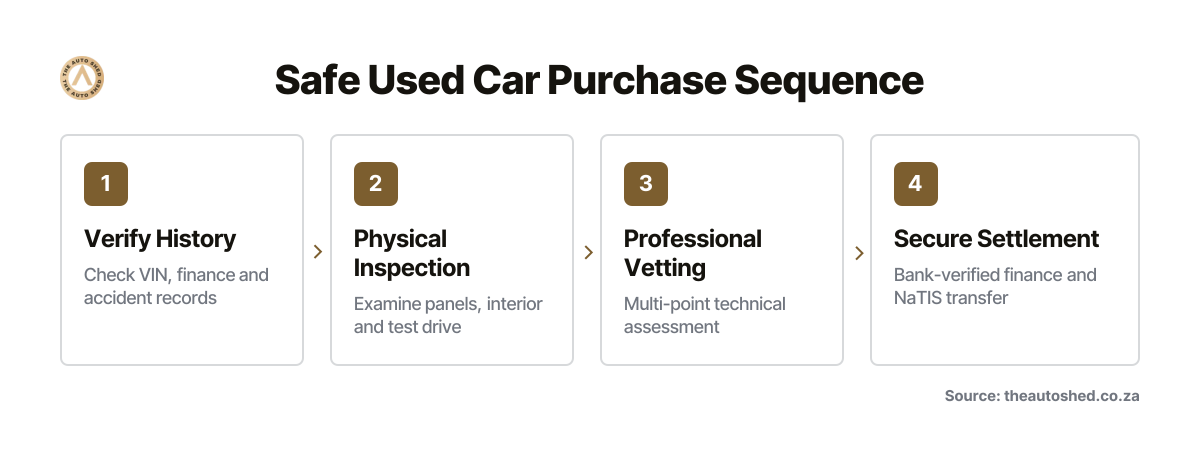
A professional inspection turns subjective impressions into objective findings, backed by technical expertise and proper diagnostic equipment. Most buyers simply don't have the training or the tools to spot sophisticated fraud or an emerging mechanical failure during a casual look-over.
The Autoshed Approved Inspection Standard
Our multi-point inspection checks every vehicle against criteria built from decades of hands-on experience with premium South African specifications. We look at structural integrity, mechanical condition, electrical systems and documentation before any car enters our inventory.
This is a rigorous approach, and we reject far more vehicles than we accept. We'd rather keep standards that favour long-term reliability over short-term stock. You can review our certified pre-owned vehicle inspection checklist to see exactly what separates an approved vehicle from one we decline.
Benefits of Buying From a Trusted Dealer
Over 70% of our business comes from repeat customers and referrals. That's trust built through rigorous vetting, not volume sales, and it reflects relationships that carry across multiple purchases because clients know we put their long-term satisfaction ahead of any single transaction's margin.
A dealer purchase comes with proper transfer documentation, warranty options and after-sales support that a private seller simply can't offer, whatever the price advantage. If something unexpected comes up after the sale, having an established relationship with people who stand behind their selections is worth more than chasing a private seller who's stopped answering the phone.
Securing Safe Finance and Ownership Transfer
Financial security deserves the same attention as mechanical verification on a high-value purchase. Cash payments to private sellers, made without bank verification, expose you to theft risk and leave no audit trail if a dispute comes up later.
Legitimate financing channels make sure proper settlement procedures protect both buyer and seller through the transfer. Exploring secure used car finance options through registered institutions gives you documentation and consumer protections that informal arrangements don't.
Never release payment until the NaTIS registration documents confirm legal ownership matches physical possession, and that any outstanding finance has been cleared. A proper settlement letter from the financing institution verifies the old loan is discharged before ownership transfers.
Choosing Quality Over Bargain Prices
The lowest upfront price often hides deferred maintenance, hidden damage or a fraudulent history, and those cost far more over time than they save upfront. Premium vehicles need premium maintenance whatever you paid for them, which makes total cost of ownership the only comparison that actually matters.
Our hand-selected inventory is made up of vehicles we'd happily put in our own families' driveways, backed by verification processes built to take the guesswork out of your decision. When you view our vetted inventory, you're looking only at cars that have passed standards shaped by 28+ years of combined motor industry experience.
Quality assurance costs a bit more upfront but gives you an ownership experience free of surprise repairs and legal headaches. Established professionals know that sorting out a bad purchase costs more, in time and money, than paying a fair price for verified quality in the first place.
Frequently Asked Questions
Which cars are considered high risk in South Africa?
High-risk vehicles typically include popular bakkies and SUVs frequently targeted for theft, cloning or odometer fraud due to strong resale demand. Models with known mechanical weaknesses or expensive proprietary parts also carry elevated risk when purchased without professional inspection. Always verify specific vehicle history rather than relying solely on model reputation.
What is a red flag in a car dealership?
Dealers who pressure immediate decisions, refuse independent inspections or cannot provide complete service documentation warrant caution regardless of advertised prices. Vague answers about vehicle history, missing NaTIS papers or reluctance to allow test drives suggest potential issues being concealed. Reputable dealers welcome scrutiny because their vetting processes withstand examination.
How can I verify mileage authenticity without specialist equipment?
Cross-reference service book stamps, oil change stickers and tyre replacement records against displayed odometer readings to identify inconsistencies across time. Interior wear patterns on steering wheels, seats and pedals should correlate logically with claimed mileage figures. Professional diagnostic scans can sometimes detect electronic tampering signatures that visual inspection misses.
Does the CPA cover private car sales in South Africa?
No, the Consumer Protection Act applies only to transactions with registered dealers operating in the ordinary course of business. Private sales fall under common law voetstoots principles where buyers accept vehicles as-is with all faults. This distinction makes professional pre-purchase inspection essential when buying from individuals.