
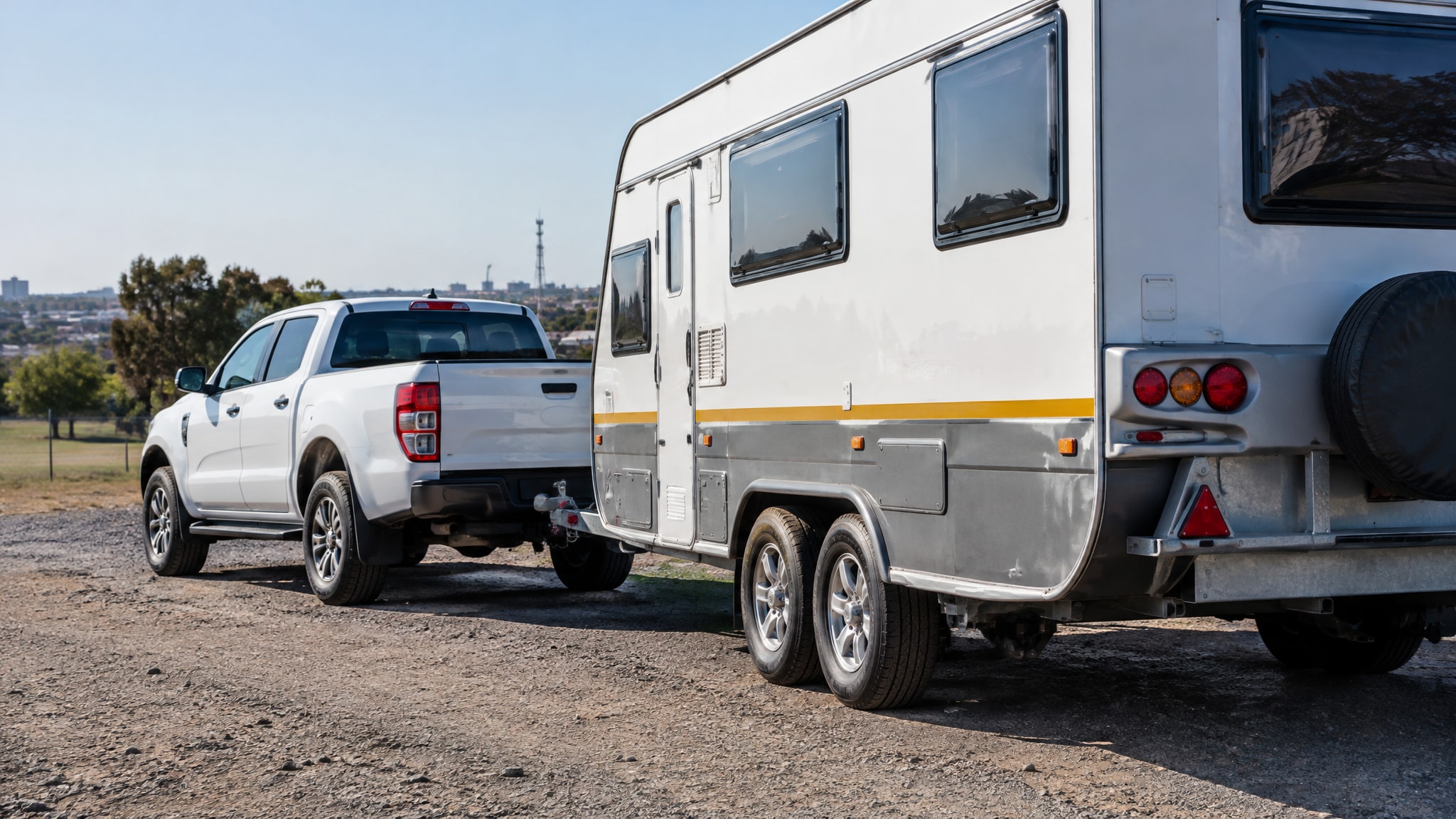
Every year, as the holidays approach, the same question reaches our showroom in Centurion: "What can I tow on my licence?" We sell bakkies and SUVs every day, so we hear it from buyers who are about to hitch a caravan, a boat or a loaded trailer for the first time.
The answer depends on three things: the code on your licence, the weight of your vehicle and the weight of what sits behind it. We'll take them in that order. Figures below come from the National Road Traffic Act and the RTMC, and the RTMC site is the place to confirm them before you set off. This is general guidance, not legal advice.
Code 8 and Code 10 explained: old codes vs new codes
South Africa changed how it labels licence codes, but the vehicles behind each label did not change. If you hold an older card, you already hold a licence that maps neatly onto the current system.
How the old codes map to B, C1 and the E codes
Old Code 8 is now Code B. Old Code 10 is now Code C1. Those are the two you will meet most often when you shop for a bakkie or SUV.
Code B covers light vehicles with a gross vehicle mass (GVM) of up to 3,500 kg. Code C1 covers heavier vehicles above that, up to 16,000 kg GVM, such as larger minibuses and light trucks.
The "E" codes are about trailers. EB means a Code B vehicle pulling a trailer above 750 kg GVM, and EC1 means the same for a C1 vehicle. So if you see "EB" on a licence, it tells you the holder passed a test with a heavier trailer attached.
What happens if your licence was issued before the changes
An older licence stays valid. You do not need to retake a test simply because the labels changed, and a Code 8 holder is treated as a Code B holder.
What you should do is check the card itself, because it lists the exact codes you hold. When the card comes up for renewal, the replacement carries the current wording. If yours is close to expiry, our guide to renewing your driving licence walks through the process.
What a Code 8 (B) licence lets you drive
Yes, you can drive a bakkie on a Code 8. Most buyers who ask us this are relieved to hear it.
The rule is about weight, not body shape. A double-cab bakkie, a family SUV or an executive sedan is fine on Code B as long as its GVM stays at or below 3,500 kg. You will find the GVM on the vehicle's plate and in its documents, so check it rather than assuming.
A Code B licence also lets you pull a light trailer, up to 750 kg GVM. That covers a small utility trailer or a jet-ski trailer, but not most caravans. For anything heavier, you move into EB territory, which we cover below.
Most of the bakkies and SUVs we sell sit comfortably within the Code B limit. If a vehicle you are eyeing looks unusually heavy, read the GVM before you fall in love with it.
When you need a Code 10 (C1) licence
You need Code C1 when the vehicle itself is heavier than 3,500 kg GVM. The licence follows the vehicle, not the badge on the bonnet.
Minibuses, light trucks and heavier vehicles
Larger minibuses, light trucks and other heavier vehicles sit above the Code B limit, and Code 10 (C1) is the licence for them. If you carry paying passengers or goods for reward, you may also need a professional driving permit, so ask your licensing office what applies to you.
Code 10 is not simply "better" for a private bakkie or SUV driver. It does not let you tow more with a bakkie, and it does not raise your vehicle's rated capacity. It only matters once the vehicle crosses that 3,500 kg line.
For the bakkies and SUVs most of our customers drive, Code B is the licence that counts. Code 10 is for a different kind of vehicle altogether.
Towing a caravan or trailer: do you need EB?
You need EB once the trailer is heavier than 750 kg GVM. Below that, Code B is enough.
That is the line most holidaymakers cross without noticing. A fully loaded caravan almost always sits above it, so a Code B licence on its own will not cover it.
Simple table: vehicle + trailer = licence needed
| Vehicle (GVM) | Trailer (GVM) | Licence needed |
|---|---|---|
| Up to 3,500 kg | Up to 750 kg | Code B |
| Up to 3,500 kg | Above 750 kg | Code EB |
| 3,500 kg to 16,000 kg | Up to 750 kg | Code C1 |
| 3,500 kg to 16,000 kg | Above 750 kg | Code EC1 |
Read the trailer's GVM from its plate, not from how it looks. A Code B licence can tow a caravan only within these permitted limits, and the limit is on the trailer's mass, not its size.
Common holiday set-ups: caravans, boat trailers and utility trailers
A small utility trailer with a quad bike or a few bags of building supplies usually stays under 750 kg. Code B covers it.
A boat trailer is more varied. A small fishing boat on a light trailer may fit within Code B, while a bigger boat with engine, fuel and gear can push the combination into EB.
A caravan is the one to check most carefully. Look at its GVM plate: the licence rule uses the trailer's rated GVM, not how lightly you pack it, and almost every caravan is rated above 750 kg. If yours is, you need EB. There is no simple upgrade from B to EB; you redo the learner's and driving tests with a trailer attached, so book well before the school holidays, not the week before.
An EB licence does not make a vehicle safe to tow with. It only means you are legally qualified, and the vehicle's own limits still apply, as the next section shows.
Towing capacity of popular bakkies and SUVs
Every figure in this section needs to come from the manufacturer's South African spec sheet for your exact model year and derivative. Towing capacity changes between engines, drivetrains and years, so we would rather send you to the source than print a number that may not match your vehicle.
Three things can cap what you may legally tow, whatever the brochure says:
- the tow bar's own rating.
- whether the trailer is braked or unbraked.
- the vehicle's GVM and the combined mass it is rated to pull.
Your licence code does not change any of them. A licence lets you drive the combination, but the vehicle still has to be rated for it.
Bakkies: Ford Ranger and GWM P-Series
Double-cab bakkies are the usual choice for caravans and boats, and the Ford Ranger and GWM P-Series are two we are asked about often. We currently have a 2024 Ford Ranger 2.0 SiT XLT 4x4 double cab and a 2024 GWM P-Series 2.0TD LT 4x4 double cab in stock. Look up the braked towing figure for the specific derivative you are considering, and note whether it differs between manual and automatic or between two- and four-wheel drive.
If you are weighing the P-Series against an established rival, our comparison of a Chinese bakkie vs a used Hilux covers the buying side.
SUVs: Toyota Fortuner, Land Cruiser and Land Rover Defender
The Toyota Fortuner, Land Cruiser and Land Rover Defender are all popular with owners who tow. Again, the spec sheet for your model year and derivative is the figure that counts, and the Defender in particular varies between the 90 and 110 and between engines.
On our floor right now are a 2019 Fortuner 2.8 GD-6 auto, a 2009 Land Cruiser 200 4.5 V8 diesel, and both a 2021 Defender 90 and a 2021 Defender 110. Our Toyota Fortuner buying advice is a good next read if you are still choosing, and the best used luxury SUVs list shows where the Defender sits among its peers.
Is Code 10 better than Code 8? Choosing the licence for your vehicle
No. Get the code your vehicle and trailer actually require, not the highest one on offer.
If you drive a bakkie or SUV under 3,500 kg GVM and tow only light trailers, Code B is all you need. If you plan to tow a caravan or a heavy boat trailer, add EB. If you will drive vehicles above 3,500 kg GVM, that is when Code 10 (C1) earns its place.
Paying for a higher code you will never use costs you time and money without changing what you can safely tow. Matching the licence to the job is the more sensible route.
If you are new to all this, starting with a learner's licence is the first step towards Code B. Renewals and replacement cards are covered in the renewing your driving licence guide above.
Towing tips for the holidays
A caravan or boat puts a heavy, sustained load on your vehicle, so its condition matters as much as your licence. Every vehicle we sell goes through the Autoshed Approved inspection and a Dekra roadworthy test, which is why we ask towing customers to check the basics before a long haul.
Tow bar, load and tyre pressure
Start with the tow bar. It should be correctly fitted, rated for the weight you intend to pull, and free of rust or play in the coupling.
Then think about the load. Pack heavier items low and close to the trailer axle, because a poorly balanced trailer sways, and sway is hard to correct at speed.
Tyre pressures are the next check, on the vehicle and the trailer. Follow the pressures the manufacturer gives for a loaded vehicle, and look over the tyre walls for cracks or bulges, because a long holiday drive in summer heat is hard on old rubber.
Brakes deserve a look too. If your brakes are tired, a trailer will find that out before you do.
Mirrors, speed and braking distance
Towing mirrors let you see past the trailer, and without them you are driving partly blind. Fit them before you leave, not at the first lay-by.
Drive slower than you normally would. A heavier combination takes far longer to stop, so leave a larger gap to the vehicle ahead and brake early and gently.
Before you leave, also check for unpaid traffic fines before festive roadblocks. It is a small job that can save you an awkward delay on the road.
Need a bakkie or SUV that can tow?
If a tow-ready vehicle is on your list this season, browse our bakkies and SUVs or WhatsApp us on 077 600 5558. We will help you match the vehicle to what you plan to pull, arrange finance through the major banks, take your current car as a trade-in, and deliver nationwide.
If a vehicle isn't good enough for our family, it isn't good enough for yours.
Frequently asked questions
Can I drive a bakkie on a Code 8 licence?
Yes, as long as the bakkie's GVM is no more than 3,500 kg. Most double-cab bakkies fall within that limit. Check the GVM on the vehicle's plate or documents to be sure.
Can I tow a caravan with a Code B licence?
Only if the caravan's GVM is no more than 750 kg. Almost all caravans are rated above that, in which case you need an EB licence. Read the GVM from the caravan's plate, not its size or how full it is.
What is a Code 10 licence for?
Code 10, now C1, covers vehicles above 3,500 kg GVM, up to 16,000 kg, such as larger minibuses and light trucks. It is not needed for a normal bakkie or SUV, and it does not increase what your vehicle can tow.
How do I upgrade from Code 8 to Code 10?
You apply for the new code at your local driving licence testing centre and pass the required tests. Ask the centre what applies to your situation, as requirements are set by the National Road Traffic Act and RTMC. Only do this if you will actually drive heavier vehicles.