

October brought a confirmed R3.28 per litre petrol price hike. For South African motorists, particularly those managing premium vehicle running costs, that's more than a headline figure. It resets monthly budget expectations and shapes decisions about which vehicle to own. Understanding where prices might settle means looking past the immediate shock to the market mechanics that drive our local fuel costs.
Understanding the Impact of October's R3.28 Per Litre Increase
This is a real shift in operating costs, not a minor fluctuation, and anyone who relies on private transport for daily commuting or business logistics should take note. You'll feel it most if you drive a larger engine or cover high monthly mileage, because the cost compounds quickly over a billing cycle.
How the latest adjustment affects monthly motoring budgets
A R3.28 increase means less discretionary spending at home, or higher overheads for businesses running a fleet. Each tank fill only costs marginally more, but across weeks of travel that adds up to real pressure on household cash flow and corporate expense accounts. It forces a rethink of what counts as acceptable fuel consumption for your primary vehicle.
Why mid-month assessments matter for November planning
Mid-month assessments give you visibility into whether November will bring relief or continued pressure, before the official government gazette lands. Wait for the first Wednesday of the month and you're reacting rather than planning, possibly locked into higher costs before you can adjust your travel or vehicle usage. Watch the interim data instead, and you can get ahead of the trend on fuel purchasing or route planning.
Key Drivers Influencing the November Petrol Price Adjustment
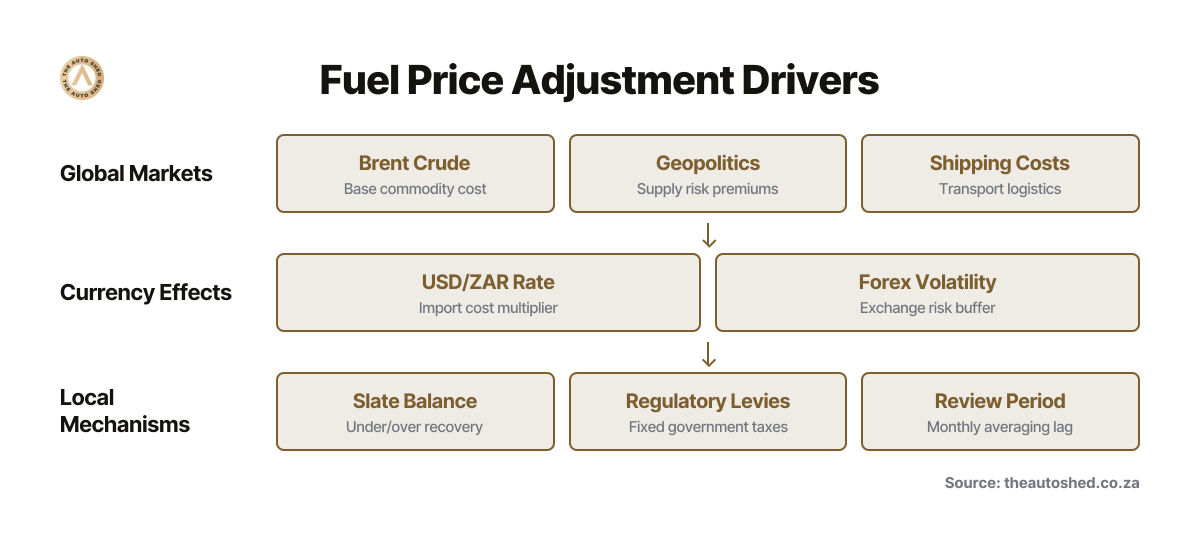
Domestic fuel pricing doesn't operate in isolation. It responds to international variables that often move independently of what's happening in our own economy. The Department of Mineral Resources and Energy adjusts prices based on average import parity, so global shifts take time to reach your local forecourt.
Global crude oil market movements and rand exchange rates
Brent crude pricing and ZAR/USD volatility typically drive domestic pump adjustments, and weakness in either one pushes costs upward. Even if global oil prices settle, a depreciating rand can wipe out those gains, because we buy our fuel in dollars. Tracking forex markets matters as much as watching energy news when you're trying to forecast fuel spend.
The role of international geopolitical tensions on local fuel costs
Global supply disruptions tend to create a lag effect. October's hike may still reflect earlier market shocks rather than what's happening in November. Conflicts in key production regions or at shipping chokepoints add risk premiums that outlast the headlines, keeping barrel prices elevated even when physical supply is fine. Current pump prices often reflect yesterday's anxieties more than today's availability, which is exactly what makes short-term predictions so unreliable.
Will Fuel Prices Go Down in South Africa This November?
Many motorists hope for immediate relief after a steep increase, but unregulated petrol pricing runs on averages, not sentiment. Significant monthly hikes often trigger a period of correction or stabilisation once international crude markets soften, though the timing depends on exchange rate lags and inventory cycles.
Analysing current under-recovery and over-recovery trends
Price reductions only happen once the cumulative slate balance shows enough over-recovery to offset previous deficits and current import costs. If barrel prices have softened consistently through the review period and the rand held steady, the case for a decrease strengthens. But partial recoveries are common, so even favourable conditions might bring only a modest rollback rather than a full reversal of October's increase.
Historical patterns following significant monthly hikes
Past cycles suggest sharp increases like October's R3.28 adjustment often mark a ceiling rather than a new floor, assuming external shocks don't escalate. Markets tend to overshoot during panic buying, then correct as demand drops and suppliers adjust output to match it. History offers no guarantees, but recognising these cycles helps you tell a temporary spike from a structural shift that calls for longer-term adaptation.
This explains the market mechanics. It can't predict exact future pump prices or promise specific savings for your household budget.
Practical Strategies to Manage Rising Fuel Costs
When the price factors are beyond your control, the focus shifts to what you can manage: your own efficiency. Disciplined maintenance and smarter driving reduce litres consumed per kilometre regardless of what's happening at the pump.
Optimising driving habits for better consumption
Smooth acceleration and anticipatory braking improve real-world economy by keeping the engine in its optimal torque band and cutting wasted kinetic energy. Steady highway speeds below 120 km/h also pay off disproportionately, because aerodynamic drag rises sharply with speed and forces the engine to work harder than it needs to. These habits cost nothing and show up at every fill-up.
Evaluating vehicle efficiency against current price realities
Regular servicing keeps tyre pressures, air filters and spark plugs within spec, which stops hidden mechanical issues from eating into factory-rated consumption. If your current vehicle consistently drinks more than the manufacturer claims, despite proper maintenance, it might be time to look at alternatives built for today's cost environment. Our guide to the best fuel efficient cars in South Africa covers models that balance performance with genuine economy.
Choosing Fuel-Efficient Premium Vehicles in a High-Cost Environment
Choosing the right vehicle is a hedge against volatile petrol prices. It turns a fixed luxury preference into something you can sustain long-term. Modern premium bakkies and SUVs are far more efficient than their predecessors, thanks to better transmissions, turbocharging and lighter materials, without giving up comfort or capability.
Balancing luxury performance with running cost sustainability
You don't need to give up refinement to get sensible consumption. Today's engineering delivers both, in vehicles suited to South African roads and the way we actually live. Our piece on premium used SUVs balancing performance and economy looks at options where hybrid systems or efficient diesel powertrains cut your exposure to pump price swings. It's an approach that keeps the vehicle an asset rather than a liability when times are uncertain.
Why certified pre-owned inspections matter for long-term economy
Our Autoshed Approved inspection checks engine health and real-world consumption, so the premium pre-owned vehicles we sell actually deliver the fuel efficiency they promise. Worn injectors, a clogged catalytic converter or a failing oxygen sensor can quietly cut economy by twenty percent or more, wiping out any advantage you thought you were buying. Our certified pre-owned inspection checklist shows how thorough vetting protects you from a hidden fuel guzzler dressed up as an economical choice.
If a vehicle isn't good enough for our family, it isn't good enough for yours. Have a look through our fuel-conscious premium inventory to find something that meets both your standards and your budget.
Looking Ahead: Monitoring Future Fuel Price Indicators
Staying informed between official announcements lets you time a purchase, trade-in or service around the shifts you can see coming, rather than reacting after the fact. Watch Brent crude futures and the USD/ZAR exchange rate daily. Sustained moves in either direction usually signal an adjustment within two to three weeks, and that's the kind of foresight that turns a volatile market into a manageable one.
Frequently Asked Questions
Will fuel prices definitely decrease in November after October's hike?
No outcome is guaranteed as adjustments depend on cumulative import parity calculations including crude prices and exchange rates. Significant hikes often precede corrections if international markets soften, but rand weakness or renewed geopolitical tension could sustain current levels. Monitor mid-month data for directional signals rather than expecting automatic reversals.
Why don't lower global oil prices immediately reduce South African pump prices?
Local prices reflect average import costs over a review period, not real-time spot market values, creating inherent lag effects. Currency depreciation can also offset crude price declines since fuel is imported in US dollars. Additionally, previous under-recoveries must be recouped before any surplus translates into pump price reductions.
How much can better driving habits actually save on fuel costs?
Smooth driving and proper maintenance typically improve real-world consumption by ten to twenty percent compared to aggressive or neglected vehicles. At current prices, this translates to hundreds of rands saved monthly for average commuters covering standard distances. The savings compound over time, making behavioural changes one of the most effective immediate responses to price hikes.
Is now a good time to trade in my vehicle for something more efficient?
High fuel costs make efficiency upgrades financially compelling if your current vehicle consumes significantly more than modern equivalents. Certified pre-owned inspections ensure you acquire genuine economy rather than inheriting hidden mechanical issues that worsen consumption. Consider your monthly mileage and intended ownership period to calculate whether projected fuel savings justify the transaction costs.