

Signing the finance agreement is just the opening chapter of vehicle ownership. Many buyers focus on the monthly repayment and overlook what comes after. Working out what a car really costs to run each month in 2026 means looking past the sticker price at fuel, insurance, maintenance and depreciation together, not as separate line items.
We have found that buyers who budget for total cost of ownership enjoy far more peace of mind than those who stretch their finances for a higher-spec model with unpredictable running costs. If a vehicle isn't good enough for our family, it isn't good enough for yours, and that includes making sure you can comfortably afford every part of ownership long after you drive off the forecourt.
The True Monthly Cost of Car Ownership in 2026
Accurate budgeting means separating fixed contractual obligations from variable usage costs, so you get a picture of affordability that survives daily life. Fixed costs include your finance instalment, comprehensive insurance premium and licence renewal fees; these stay constant regardless of mileage. Variable expenses like fuel, tolls and unscheduled repairs move depending on how and where you drive.
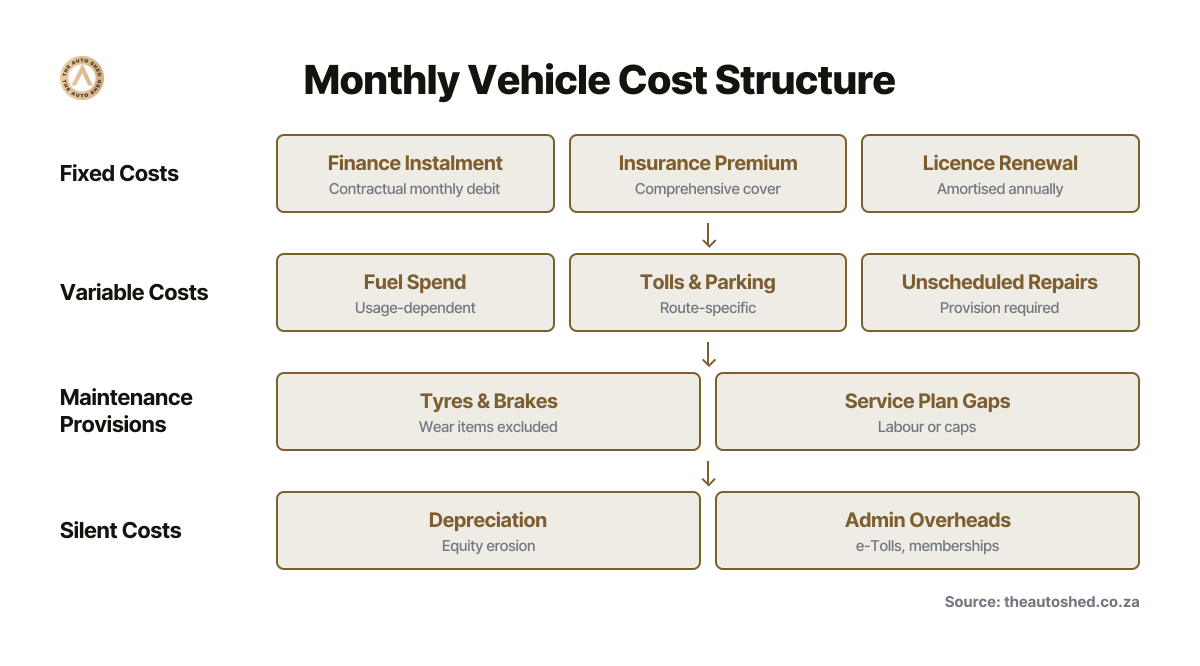
Beyond the Instalment: Fixed vs Variable Expenses
Most household budgets fail because they treat the bank debit order as the only measure of transport cost. That ignores the hundreds of rands spent weekly on petrol and ad-hoc mechanical needs. Allocate funds specifically for variable expenses, so you're not dipping into savings or credit when fuel prices move or an unexpected repair comes up.
Fixed costs give you a baseline for planning. Variable costs decide whether your vehicle stays an asset or becomes a burden during months of high travel or tight budgets.
Why Premium Used Vehicles Offer Predictable Budgeting
New vehicles often carry steep depreciation curves, so the true monthly cost runs higher than the repayment suggests once you factor in residual value. Our team brings over 28 years of combined motor industry experience to every valuation, so buyers understand the true long-term cost of their choice before committing capital.
Vehicles going through our Autoshed Approved inspection process have wear items assessed upfront, which prevents surprise maintenance bills shortly after purchase. You inherit a known quantity rather than a gamble, so you can forecast maintenance spend with confidence instead of bracing for unknown defects.
Predictability matters more than lowest price when your professional reputation depends on reliable transport.
Fuel Price Volatility and Efficiency Realities
Petrol prices adjust regularly in South Africa, so your fuel budget needs to allow for volatility rather than assume current rates will hold for the life of your ownership. Calculate your real-world consumption from local driving conditions and typical traffic, not manufacturer claims achieved under laboratory conditions that bear little resemblance to a Gauteng commute.
Calculating Your Real-World Consumption
Manufacturer specifications are a useful comparison point between models, but actual consumption in mixed urban and highway driving typically runs well above these figures. Track your fuel spend over three full tanks. That gives you a personal baseline reflecting your route, load and driving style.
This kind of real data is worth more for budgeting than brochure statistics when you're working out what a car really costs to run each month in 2026.
Downsizing or Hybrid: What Makes Financial Sense?
Choosing a vehicle that balances performance with economy means being honest about your actual needs rather than the aspirational ones that inflate running costs. We recommend reviewing our guide to the best fuel efficient cars in South Africa to find models with adequate power without excessive consumption in local conditions.
Hybrid technology pays off for high-mileage urban drivers, but the premium purchase price only makes sense if your annual distance closes the gap through fuel savings. Diesel may suit long-distance commuters better, though particulate filter maintenance adds a variable cost that petrol hybrids avoid.
Financial sense comes from matching the powertrain to your verified usage, not chasing trends.
Insurance Premiums and Risk Mitigation Strategies
Insurers assess risk differently for premium bakkies and SUVs than for passenger sedans, particularly in Gauteng where theft and hijacking statistics shape rating factors. Get multiple quotes before you buy any vehicle. Premiums can vary dramatically between insurers for identical models, because each prices risk against its own claims experience.
How Vehicle Choice Influences Your Rate
High-performance variants and imported models without local assembly support often attract higher premiums, because of repair costs and parts availability. A mainstream premium brand with an established dealer network typically gets more favourable insurance terms, since assessors can price the risk with more certainty.
Your excess structure also affects monthly cost, so talk to your broker about voluntary excess options and find a balance between premium savings and out-of-pocket exposure you can actually afford.
Do Trackers and Safety Tech Actually Lower Costs?
Approved tracking units and telematics devices often qualify a vehicle for a discounted premium, but the saving has to outweigh the subscription cost to be worth it. Read our analysis on whether trackers actually lower your insurance premium to see which devices insurers recognise and what documentation you need to get the discount.
Factory-fitted safety features like autonomous emergency braking and lane departure warning also influence ratings, though aftermarket installations rarely get the same recognition as OEM equipment. Verify eligibility with your insurer before you invest in any device. Assuming a discount applies when it doesn't is how budgets come up short.
Technology reduces risk, but only verified technology reduces premiums.
Maintenance, Servicing and Tyre Replacement Cycles
Scheduled service plans cover routine maintenance at set intervals, but they exclude wear items like tyres, brake discs and wiper blades, which add up to a real periodic expense. Budget separately for these consumables so you're not caught out when replacements fall due outside warranty cover.
Budgeting for Scheduled Service Plans
A vehicle with a remaining manufacturer maintenance plan stabilises cash flow for the first few years, because servicing costs are locked in at pre-paid rates. Check the plan's terms carefully. Some exclude labour or cap claim values in ways that leave you exposed.
Our certified pre-owned vehicle inspection checklist sets out exactly what we assess to prevent future maintenance surprises, so you can see upcoming wear item replacements before you buy.
The Hidden Cost of Neglecting Wear Items
Putting off tyre replacement or brake service to manage short-term cash flow raises long-term costs through faster component wear and, potentially, damage to safety systems. Set aside a monthly provision for wear items even when nothing is due yet. That builds a reserve that smooths spending across the years you own the car.
Neglect compounds expense. Proactive maintenance protects both vehicle value and budget predictability.
Depreciation and Residual Value Management
Depreciation is the largest single cost of vehicle ownership despite never appearing on a monthly statement, and it quietly erodes your net wealth every year. Premium used vehicles with full service history typically hold their value better than those with gaps, which protects your equity directly.
Which Models Hold Value Best in SA?
Toyota and Ford bakkies have historically held residual value well in the South African market, thanks to strong demand and a reputation for reliability. Luxury SUVs from established German marques also hold up when serviced to the manufacturer's schedule, though niche performance variants drop off faster.
Use our trade-in value calculator to estimate residual values for specific models and base your decision on data rather than sentiment.
Brand selection determines depreciation trajectory more than any other factor you control.
Timing Your Trade-In for Maximum Return
Vehicle values don't decline in a straight line. The steepest drops come right after new model launches and at major mileage marks like 100,000 kilometres. Trading in before those points preserves equity that would otherwise disappear, which lowers the effective monthly cost of ownership even though no cash changes hands.
Over 70% of our business comes from repeat customers and referrals. We think that reflects what happens when cost advice is honest rather than persuasive.
Licensing, Tolls and Administrative Overheads
Annual licence renewals, toll fees on routes you use regularly and roadside assistance memberships are fixed costs that plenty of owners forget to spread into their monthly budget until the lump sum lands. Divide these annual expenses by twelve and set the amount aside monthly, so December doesn't turn into a cash flow crisis when licence renewals land alongside holiday spending.
Administrative overheads are predictable if you choose to treat them that way, turning annual surprises into monthly provisions that protect your wider finances.
Building a Sustainable Vehicle Budget for Your Family
Sustainable affordability means pulling all the cost factors together into one monthly figure: finance, fuel, insurance, maintenance provisions and a depreciation estimate. We'd rather see honest financial assessment than an emotional purchase, because loving a vehicle you can't comfortably maintain ends up costing you more than it gives back.
Using Our Finance Tools to Model Affordability
Our vehicle finance options let you model different deposit structures, balloon payments and term lengths to find a repayment that leaves room for running costs. Use these tools conservatively. The maximum amount you're approved for reflects lending criteria, not what you can personally afford.
Budget for the vehicle you can sustain through the lean months, not just the one you qualify for today.
Why Transparency Matters in Pre-Owned Purchases
Hidden defects and undisclosed accident history turn an affordable vehicle into a financial liability, which is why verification matters as much as negotiating the price. Our family-first approach means we would rather walk away from a sale than put you in a vehicle that puts your finances at risk through costs you didn't see coming.
Frequently Asked Questions
How do I calculate my real monthly fuel cost in South Africa?
Track your actual fuel consumption over three full tanks under normal driving conditions, then multiply litres used per 100km by current petrol price and your expected monthly distance. Add a 10-15% buffer for price volatility and seasonal air conditioning use to create a realistic budget figure rather than relying on manufacturer claims.
Does buying a used car with full service history really save money long-term?
Yes, because complete service records demonstrate proper maintenance and reduce uncertainty about mechanical condition, which lowers both immediate repair risk and future depreciation. Subsequent buyers also value documented history, which translates to stronger resale values compared to vehicles with gaps.
What administrative costs should I budget for beyond my car payment?
Factor in annual licence renewal fees, regular toll fees, roadside assistance subscriptions and any outstanding traffic fines, dividing each annual amount by twelve for monthly provisioning. These fixed costs are entirely predictable if tracked proactively, but become cash flow shocks when left until renewal notices arrive.
How does depreciation affect my true monthly cost of ownership?
Depreciation reduces your vehicle's equity monthly even though no cash leaves your account, effectively costing you the difference between purchase price and eventual trade-in value spread across ownership months. Choosing models with strong residual value retention and maintaining full service history minimises this silent expense, which often exceeds fuel and insurance combined.