

Most of the people who walk into our showroom in Centurion have already chosen a vehicle in their heads. What they haven't done is look at their credit report. That's a pity, because the report is the first thing a bank reads, and it's far better to see it before they do.
This guide shows you how to check your credit score properly, what it means, and what to do if it isn't where you'd like it. We've spent 28+ years of combined motor industry experience watching how finance applications go, and the buyers who prepare are the ones who have the smoothest time.
What a Credit Score Is and Who Calculates It
A credit score is a number built from your credit history: how you've repaid accounts, how much you currently owe, how long you've had credit and how often you've applied for more. It tells a lender how likely you are to repay, compared with other borrowers.
It is a ranking of risk, not a verdict on your character: the number places you relative to other borrowers, rather than measuring you against a fixed standard. In South Africa, how it works is shaped by the credit bureaus and the National Credit Act (NCA).
In South Africa, the credit bureaus calculate and hold your record. The main ones are TransUnion, Experian and XDS. Compuscan, a name you may still see, is now part of Experian. Each collects data from banks, retailers and other lenders, and each uses its own scoring model.
That means your score at one bureau can differ from your score at another, and the band labels differ too. One bureau's "good" may not sit in the same place as another's, so compare a score with the bands on the same report, not with a friend's number from a different bureau.
We don't favour any bureau, and you shouldn't feel you have to either.
How to Check Your Credit Score for Free, Step by Step
You don't need to pay to see where you stand. The law gives you a free route, and it doesn't touch your record.
Your Free Annual Credit Report Under the NCA
Under the National Credit Act, you're entitled to a free credit report from each registered credit bureau once every 12 months. A report shows your accounts, payment history, enquiries and any adverse listings. Some bureaus also show the score alongside it, though the free report and a paid score product aren't always the same thing, so read what each one includes before you request it.
Checking your own report is a soft check, so it shouldn't lower your score. That's different from a lender running a credit check after a formal application, which is recorded as an enquiry.
Step-by-Step: Requesting Your Report Through Official Bureau Channels
Stick to the bureaus' own official websites. Look-alike sites and unsolicited messages offering "instant scores" are a common way for personal details to leak.
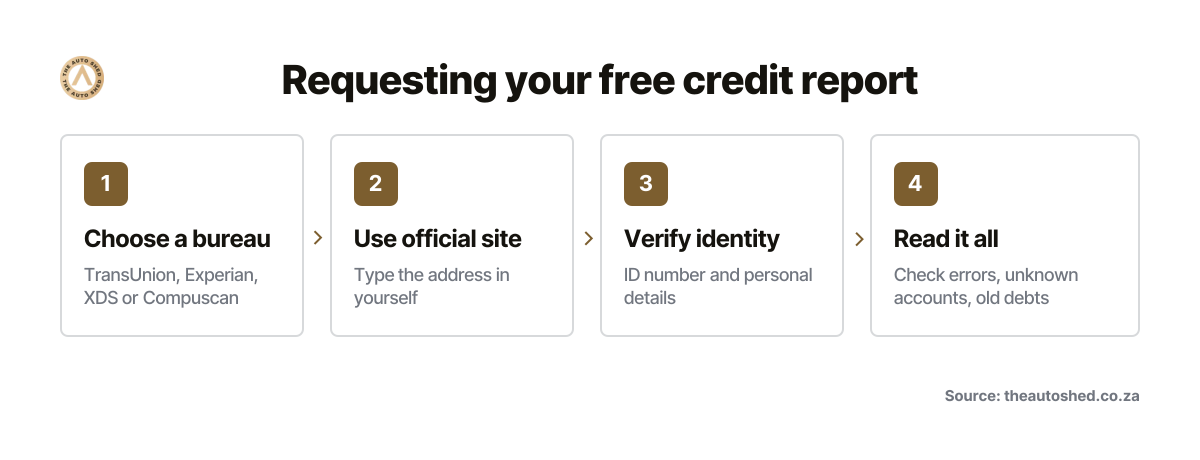
- Choose a bureau. TransUnion, Experian and XDS all offer the free annual report. Because each holds slightly different data, you can request from more than one, since your free entitlement applies to each of them.
- Go to its official website. Type the address in yourself rather than following a link in a message.
- Verify your identity. Expect to supply your ID number and some personal details so the bureau can match you to your file.
- Request the free report. Follow the consumer route on the site, and keep the confirmation.
- Read the whole report. Don't stop at the number.
Reading the report is where the real value sits, because the number is only a summary of what's in it. As you go through it, look for:
- accounts you don't recognise, which can point to fraud or identity theft
- balances that look wrong, or accounts you closed that still show as open
- late payments you're sure you made on time
- old debts that you've settled but which still appear as outstanding
If something is wrong, tell the bureau and the credit provider concerned, and ask for it to be corrected. We'll come back to that in the improvement plan below.
What Score Do You Need for Car Finance?
Buyers ask us this more than anything else. The honest answer is less satisfying than a number, but it's the one that holds up.
Why There Is No Magic Number
No minimum score guarantees finance. Nobody can promise you approval from a score alone, and we won't name a figure, because lenders set their own criteria and weigh the whole picture of an application.
Bureaus describe scores in bands, usually running from poor through fair and good to excellent, and a higher band generally helps. A stronger band can mean a wider choice of lenders and often better terms, but a lower one isn't an automatic no.
A good score also doesn't guarantee a yes, because the score is one input among several.
What Banks Look at Besides Your Score
Lenders have to be sure you can afford the instalment, and the NCA requires them to assess that. So alongside your report, expect them to look at:
- Proof of income, usually recent payslips for salaried applicants and bank statements for anyone else
- Existing debt, such as home loans, card balances, store accounts and other instalments
- Monthly obligations, meaning the money already committed before a car repayment is added
- The deposit and the vehicle, since a larger deposit changes how much the bank is lending
Two people with the same score can get different answers because their incomes and commitments differ. If you want a sense of where you fall, our guide on what salary you need to buy a car walks through the budget side.
Interest rate is the other half of the picture. It moves your instalment up or down, so it helps to understand how the prime rate affects car repayments before you commit to a figure.
What Pulls Your Score Down
Most damage comes from a few habits. Here are the usual causes, in the order they tend to matter:
- Missed or late payments. Payment history carries the most weight, so a handful of late instalments can outweigh years of good behaviour.
- High card and store account balances. Running a credit card close to its limit tells lenders you rely heavily on credit, even if you pay the minimum on time.
- Many applications in a short period. Each formal application leaves an enquiry on your report, and a cluster of them can look like financial stress.
- Adverse listings. Judgments, defaults and similar entries stay on your record for a time and weigh heavily.
If you already have adverse listings, don't assume the door is shut. We've written a separate guide on car finance when you're blacklisted that explains where you stand and what your options are.
How to Improve Your Credit Score Before You Apply: A 3–6 Month Plan
If you're planning to buy in a few months, you have time to make a difference. Progress varies from person to person, and nothing here is guaranteed to move your score by a set amount, but each step removes a reason for a lender to hesitate.
Months 1–2: Fix Errors and Get Payments Current
Start with the report you requested. If you've found an error, such as a paid-up account still showing a balance or an account that isn't yours, dispute it with the bureau and tell the credit provider as well. Keep your proof of payment to hand, because it speeds things up.
Next, bring every account up to date. If you're behind on anything, contact the lender and arrange to clear the arrears, since a current account helps more than one that stays overdue. Set up debit orders for the essentials so that you're not relying on memory.
Don't skip the unglamorous part: write down every account you hold and what you owe on each.
Months 3–6: Reduce Balances and Pause New Credit
Now turn to your revolving credit. Pay down card and store account balances, starting with whichever is closest to its limit, because lower utilisation is a signal lenders respond to.
Hold off on new credit during this window. No new store cards, no new loans, and no applications to "see what you'd qualify for", since each formal application adds an enquiry.
A few weeks before you apply, request your report again, from the same bureau if you can, to see what's changed. A final look means no surprises when the bank sees it.
This plan won't erase serious adverse listings, and it won't suit anyone who needs a vehicle next week. For that situation, a conversation with a finance team is more useful than waiting.
Why Applying Through a Dealer Can Help
Many buyers go from bank to bank, filling in the same forms each time. It feels thorough, but every formal application can leave an enquiry on your report, which runs against everything we've just said about too many applications in a short period.
One Application, Several Banks
When you finance through a dealer, the dealer can send a single application to several lenders at once. You complete one set of paperwork, and the banks respond with their own terms. You get to compare offers without making a string of separate applications yourself.
At The Auto Shed, we arrange finance through the major banks. Over 70% of our business comes from repeat customers and referrals, and that only happens when people feel looked after at this stage. We'll tell you plainly if we think your application needs strengthening first, and we won't push you into one.
A dealer still can't change what's on your report, and no dealer can promise approval. What we can do is show your application to more than one lender, and explain the offers that come back.
Work Out What You Can Afford Before You Apply
Set your budget first, then look at vehicles. Take your monthly income, subtract existing commitments and everyday costs, and decide on an instalment you could live with comfortably, not just one a bank might approve.
Remember that the rate changes everything. The same vehicle can cost noticeably more per month at a higher rate or over a shorter term, so test a few scenarios before you commit.
A balloon payment lowers your monthly instalment, but it leaves a large amount due at the end of the term. It suits some buyers and not others, and it's worth reading about whether a balloon payment is worth it before you choose that structure.
Know your score? We arrange finance through the major banks, with one application to several lenders, and we'll take you through it without pressure. You can apply for vehicle finance with us, browse our stock, or WhatsApp 077 600 5558 and talk it through first. Every car is Dekra roadworthy with verified service history, trade-ins are welcome and we deliver nationwide.
Frequently asked questions
Does checking my credit score lower it?
No. Checking your own report or score is a soft check and shouldn't affect it. A lender's formal credit check after you apply is different, because that is recorded as an enquiry on your report.
How often can I get a free credit report?
Under the National Credit Act, you're entitled to one free report from each registered credit bureau every 12 months. Request it through the bureau's official website. If you want to check more than one bureau, you can request from each.
Can I get car finance with a low credit score?
Possibly, but nobody can promise it, because lenders also weigh your income, existing debt and monthly obligations. A lower score can mean fewer lenders or different terms. If you have adverse listings, read our guide on finance when you're blacklisted, or speak to us directly.
Will every credit bureau show the same score?
Not necessarily. TransUnion, Experian and XDS each hold slightly different data and use their own models and band labels. Compare your score only against the bands on the same report.