

The Reserve Bank left interest rates where they were on 19 November, but the vote was close and January is already on people's minds. If you are about to finance a vehicle, the prime rate is the number that shapes your monthly instalment. Below we explain what the MPC decided, what it does to a typical car loan in rands, and what you can do about your own rate. Over 70% of our business comes from repeat customers and referrals, and these are the questions they ask us after every announcement.
Prime Rate in South Africa After the November MPC Decision
On 19 November 2026 the Reserve Bank's Monetary Policy Committee (MPC) kept the repo rate at 7.25%. That means the prime rate in South Africa stays at 10.75%.
Held, but only just.
The vote was 4–3, with three members preferring a hike. Inflation explains the split: consumer price inflation (CPI) rose to 5.2% in October, and when prices climb faster the Bank tends to raise rates to cool spending, so a committee can lean towards a hike even while it votes to hold. Some economists now expect an increase when the MPC next meets, in January 2027.
Nobody can call that decision, and we won't try.
What matters to you is simple. If you finance a vehicle this month, your rate is built on today's prime, and it could sit a little higher in the new year.
Repo Rate vs Prime Rate: What's the Difference?
Two rates get mixed up in almost every conversation about car finance. The repo rate is what the Reserve Bank charges commercial banks to borrow money. The prime rate is the benchmark those banks use when they price loans to their customers.
The link is fixed: prime equals the repo rate plus 3.5 percentage points. Today that is 7.25% + 3.5 = 10.75%. When the MPC moves repo by 0.25 of a percentage point, prime moves by the same amount, and that change flows straight through to consumer credit such as car loans.
Your own rate is a third figure. A bank quotes it as prime, or prime plus a margin, depending on how it reads your risk, so a repo move reaches your instalment because your rate sits on prime and prime sits on repo.
How the Prime Rate Affects Your Car Repayment
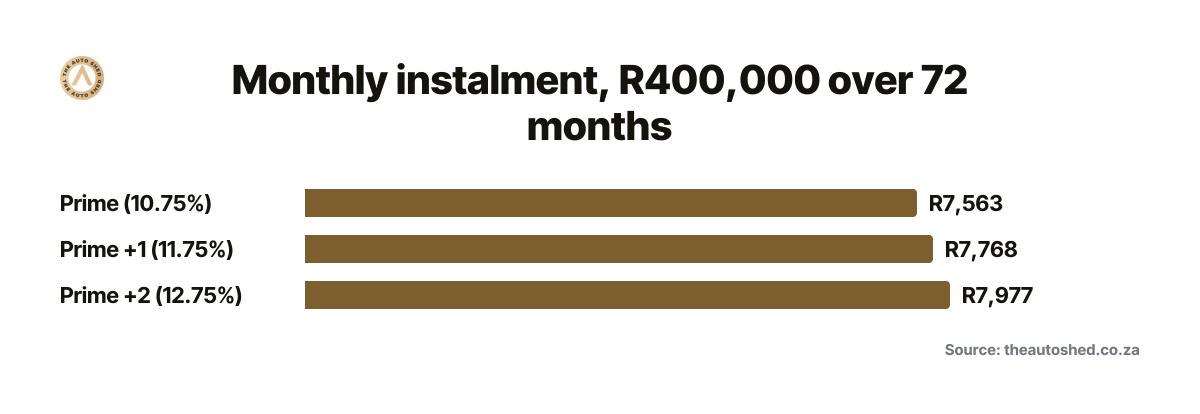
Rands make the effect easier to see than percentages do. We took a R400,000 loan, roughly the price of a 2025 Haval H6 in our showroom, over 72 months and calculated each figure with a nominal annual rate compounded monthly, rounded to the nearest rand, with no fees, insurance or balloon included.
Monthly instalments at prime, prime +1 and prime +2
The first three rows show what you would pay if a bank priced you at prime, one point above or two points above. The last row shows prime after a 0.25-point hike.
| Scenario | Interest rate | Monthly instalment | Total interest over 72 months |
|---|---|---|---|
| Prime | 10.75% | R7,563 | R144,501 |
| Prime +1 | 11.75% | R7,768 | R159,308 |
| Prime +2 | 12.75% | R7,977 | R174,341 |
| Prime after a 0.25-point hike | 11.00% | R7,614 | R148,181 |
Each extra percentage point adds a little over R200 to the instalment and roughly R15,000 to the total interest. Being priced at prime +2 instead of prime costs R414 more every month on the same vehicle, which comes to nearly R30,000 in extra interest over the term.
When you have a vehicle in mind, you can run your own numbers with our vehicle finance options. For a view from the income side, see the salary needed to afford a car.
What a 0.25% hike would add
A 0.25-point hike takes prime from 10.75% to 11.00%. On the R400,000 loan, the instalment rises from R7,563 to R7,614, about R51 a month, and the loan costs roughly R3,680 more in interest over 72 months.
That is small next to the gap between prime and prime +2, but it is not nothing, because a hike applies to every linked loan at once.
The table shows direction and scale. It is not a quote, and the rate a bank actually offers you depends on your profile.
Fixed vs Linked Interest Rates on a Car Loan
A linked rate follows prime. When prime rises by 0.25 of a point, your rate rises with it, and when prime falls, your instalment falls too.
A fixed rate stays set for the whole term, whatever the MPC does. Banks price it with the expected path of rates in mind, so you are buying certainty, and certainty has a price. Fixed suits you if a steady budget matters more than a possible saving. Linked suits you if you can absorb movement and want to benefit when rates ease. Neither is better in every case.
Why your existing loan moves when the repo rate does
If your loan is linked, it changes after an MPC move. A repo change moves prime, prime moves your rate, and your bank adjusts your instalment, usually from the next billing cycle. A fixed-rate loan does not change, however the committee votes.
Your contract states which type you have. After the November hold, nothing changes on either.
Buy Now or Wait for the Next MPC Meeting?
With a hike possible in January 2027, waiting is not free. It is not a guaranteed loss either, and our advice is the same on both sides: buy the right vehicle and finance it properly. If a vehicle isn't good enough for our family, it isn't good enough for yours, and the same standard applies to a loan.
The cost of waiting if a January hike comes
If the MPC raises the rate by 0.25 of a point, the example loan costs about R51 more a month. If it holds again, waiting has saved you nothing, and the vehicle you wanted may be gone.
We won't tell you to rush on the strength of a forecast. The Reserve Bank publishes its meeting calendar, so check the exact January date there. Seasonal pricing is a separate question, which we cover in the best time of year to buy a used car.
Why your credit profile matters more than timing
A quarter-point move is worth R51 a month on our example, while the gap between prime and prime +2 is R414. Your credit record, deposit and loan term decide where in that range you land, so they count for more than the date of the next announcement.
If your record has problems, read about car finance options if you are blacklisted before you worry about timing.
How to Get a Better Rate on Car Finance
Banks price risk. Show them less of it and the offer improves.
Deposit, credit score and a shorter term
- A bigger deposit. You borrow less, so the bank carries less risk, and that often shows in the rate as well as the instalment. We explain how much deposit you need on a second-hand luxury car.
- A healthier credit score. Pay accounts on time, keep card balances low, and avoid applying for new credit just before you apply for the loan. Check your credit report for errors too.
- A shorter term. A shorter loan raises the monthly instalment but cuts the total interest you pay, because the bank's money is out for less time.
A shorter term is not for everyone. If the higher instalment strains your budget, a longer term with a healthy deposit is the safer choice.
Comparing offers from several banks
Banks do not all price the same buyer the same way, so a single quote tells you little. Compare the interest rate, the total cost over the term, any fees, and whether the rate is fixed or linked to prime.
We arrange finance through the major banks, so one application brings you several offers to set side by side.
Balloon Payments: A Lower Instalment With a Catch
A balloon payment lowers your monthly figure by deferring part of the loan to a lump sum at the end of the term. The catch is that you still owe that lump sum, interest runs on it the whole time, and the rate still moves with prime, so a hike in the meantime makes the final bill larger. We look at whether a balloon payment is worth the lower instalment in a separate guide.
If you would like to talk it through, browse our stock at The Auto Shed or WhatsApp us on 077 600 5558. We arrange finance through the major banks, so you get several offers with one application. We also accept trade-ins and deliver nationwide.
Frequently asked questions
What is the prime rate in South Africa today?
Prime is 10.75%. The repo rate is 7.25% after the MPC held on 19 November 2026, and prime is always repo plus 3.5 percentage points.
When is the next interest rate decision?
The next MPC decision is the first of 2027, in January. The Reserve Bank publishes the exact date on its website. Some economists expect a hike, but the committee voted 4–3 to hold in November, so nobody can be sure.
Does the repo rate change my existing car loan?
It does if your loan is linked to prime. Your instalment moves after an MPC change. A fixed-rate loan stays the same for the whole term, and your contract shows which type you have.
Will my car loan be at the prime rate?
Not necessarily. Banks quote prime or prime plus a margin, depending on your credit record, deposit and term. A stronger profile usually earns a rate closer to prime.