

Ask ten people what salary they need to buy a car and you will get ten different answers. Each one is right for the person giving it. The figure that suits you depends on the price of the vehicle, the deposit you put down, the term, the interest rate and every other debt you already carry.
So we won't hand you a magic number. We will give you a method you can run in rand, using your own payslip, in about ten minutes.
Our team has 28+ years of combined motor industry experience, and most buyers arrive with a budget and a question about whether it is realistic. Over 70% of our business comes from repeat customers and referrals. That is why we would rather tell you honestly what fits than stretch you into a bigger sale.
There Is No Single Salary Needed to Buy a Car
Two people can earn the same salary and need completely different cars. One has a settled home loan, no other debt and a trade-in worth a decent deposit. The other has a store account, a personal loan and two children in school.
The first can comfortably carry an instalment the second cannot. A salary on its own tells a bank very little, and it should tell you very little too.
Five things set the real answer:
- the price of the vehicle
- the deposit and trade-in value you bring
- the loan term
- the interest rate you are offered
- your existing debt and fixed monthly costs
The sections below take them in turn. By the end you will have a monthly ceiling for the instalment and the running costs together, and that ceiling is far more useful than any rule about annual salary.
Rules of Thumb for How Much Salary Should Go Towards a Car
Personal-finance writers have long offered quick guides for car affordability. They are useful for a first sanity check. Most of them come from UK and US sources, so treat them as a starting point and adapt them to South African prices, rates and costs.
The 10% Price Rule and the 35% Gross Salary Guide
Two guides come up most often. One says the car's price should stay near 35% of your gross annual salary. The other says the monthly car payment should stay near 10% of your gross monthly income.
Both are easy to apply, and both break down quickly here. Vehicles in South Africa cost a lot relative to local salaries, so the 35% guide would put a R700,000 car out of reach for anyone earning under about R2 million a year. Yet plenty of sensible buyers afford a car at that price with a good deposit and a manageable instalment.
The guides also ignore your debts, your deposit and your term. Use them to spot a purchase that is clearly too big, not to approve one that looks fine.
Keeping the Monthly Instalment to a Share of Take-Home Pay
A more honest check is the instalment as a limited share of what lands in your account each month. Your take-home pay is what you actually spend, so it is the better yardstick.
This guide is closer to how a bank thinks, but it still has a gap. It says nothing about insurance, fuel and servicing, which sit on top of the instalment. A share that looks modest on paper can become tight once those costs arrive.
Neither guide replaces a real budget. If you want to know what a bank will approve, the answer comes from its own checks, not from a rule of thumb.
Work Out Your Car Budget From Take-Home Pay, Step by Step
This is the part to do with a calculator and your last payslip. We will walk through a typical case so you can see the arithmetic, then you can swap in your own figures.
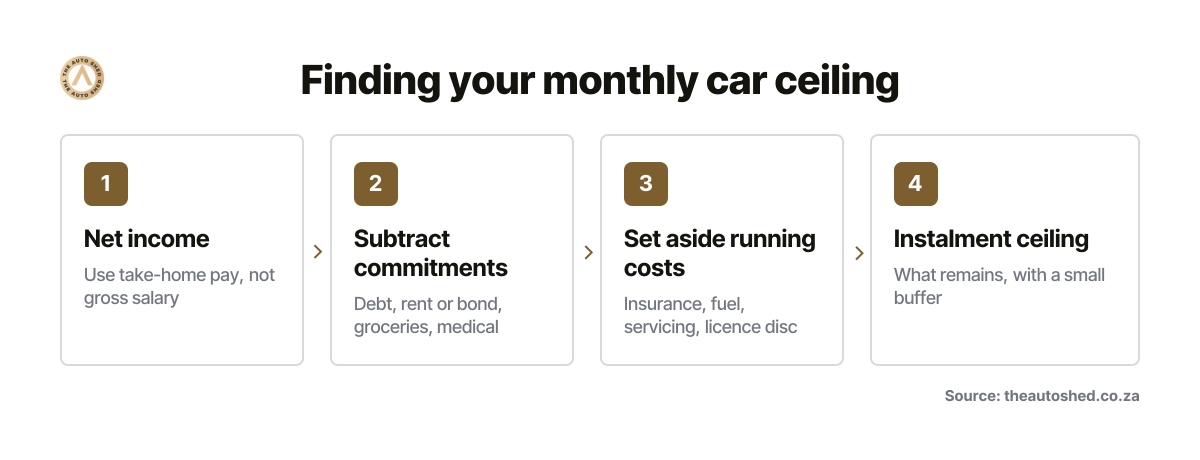
Start With Net Income, Not Gross
Gross salary includes tax and deductions you never see. Begin with the amount that reaches your bank account after tax, pension and medical aid.
In our typical case, a buyer takes home R50,000 a month. If your pay varies, use a conservative average of the last few months rather than your best one.
Subtract Existing Debt and Fixed Costs
List what leaves your account before you have spent a cent on anything else. Be thorough, because forgotten items are what sink a budget.
For the same buyer:
- existing debt repayments: R4,000
- rent or bond: R15,000
- groceries, utilities and phone: R11,000
- medical costs and savings: R10,000
That totals R40,000, which leaves R10,000 a month. Banks run a similar exercise when they assess how much of your income is already committed to debt and fixed obligations. If you want to see how that works from their side, here is a plain explanation of how vehicle finance approval works.
Calculate the Instalment You Can Carry
The remaining R10,000 is not all instalment. Running costs come out of it first. Say our buyer sets aside R3,000 for insurance, fuel, servicing and the licence disc. That leaves a ceiling of about R7,000 for the instalment, or 14% of take-home pay.
Term length then changes the picture in two ways. A longer term lowers the monthly figure, or lets you borrow more at the same instalment. However, every extra year adds interest. On the same loan, stretching the term from 60 to 72 months lowers the instalment but means you pay interest for an extra year, so the total cost of the car goes up.
Being comfortable and being approved are different things. A bank may approve you for more than you want to pay, so set your own ceiling first and keep a small buffer for the month something unexpected happens.
This also answers the R700,000 question. That price is too much if the instalment, after your deposit and trade-in, pushes you above your own ceiling. It is fine if it fits, with room to spare. Your take-home pay and commitments decide it, not the sticker.
The Costs Beyond the Instalment That Change Your Required Salary
Many buyers budget carefully for the instalment and then get surprised by what follows. The salary needed to buy a car is really the salary needed to run one, so every ongoing cost has to fit inside the same monthly number.
Insurance, Licence Disc, Service and Fuel
Four costs show up every month or every year, whatever the vehicle:
- Insurance. Premiums depend on the vehicle, your profile and where it is kept overnight.
- Licence disc. This is an annual renewal that is easy to forget until it falls due.
- Servicing and tyres. Regular services protect the car, and tyres wear out sooner than you expect.
- Fuel. Your commute and the engine you choose set this figure.
Add them up and divide by twelve, so the annual items sit in your monthly budget rather than arriving as a shock. For realistic figures, see what a car really costs to run each month.
Why Total Monthly Running Costs Matter More Than Sticker Price
Two cars with the same price can sit very far apart on monthly cost. A thirstier engine, pricier tyres or higher insurance can turn an affordable instalment into an expensive month.
When you compare vehicles, compare the instalment plus running costs, not the price alone. This is also where condition counts. Every vehicle we sell goes through our Auto Shed Approved inspection, so your budget is not eroded by surprise repairs soon after purchase.
What Kind of Car Different Salary Levels Can Realistically Support
We won't pin a rand price to a salary band, because the method above does that better. What we can say is how each band tends to approach the decision.
Entry-Level and Mid-Range Salaries: Why Used Often Makes Sense
If your salary is lower or in the middle, a quality used vehicle usually stretches it further than a new one. New cars lose value fastest in their first years, so a used car lets someone else absorb that drop. You pay less for a vehicle that still has many good years in it.
A smaller price means a smaller loan, a lower instalment and often cheaper insurance. That leaves room in your budget for the costs we listed above.
Used only makes sense when you know what you are buying. A cheap car with a doubtful history is not a saving, so insist on a full inspection and a clear service record.
Higher Salaries and Premium Pre-Owned Vehicles
With a higher salary, your options widen to premium and luxury models, including performance and executive cars, SUVs and top bakkies. A premium pre-owned vehicle can give you the specification of a newer model at a price that leaves your monthly budget intact.
Still, a bigger salary does not remove the need for a ceiling. Larger engines and premium parts carry larger running costs, and a high income with heavy commitments can feel just as tight as a modest one. If you are weighing options, our comparison of demo versus used shows how each fits a fixed budget.
Our view is simple. If a vehicle isn't good enough for our family, it isn't good enough for yours, and a car you can afford without strain is part of that.
How Deposit, Interest Rate and Loan Term Move the Numbers
Once you have a monthly ceiling, three levers decide how much car it buys. You control the deposit and the term. The rate depends partly on you and partly on the market.
Deposit and Trade-In as Salary Levers
A bigger deposit means a smaller loan, and a smaller loan needs a smaller instalment and a lower income to support it. A trade-in works the same way: any equity in your current vehicle counts as deposit. Because we handle trade-ins ourselves, you can value your current car and plan your purchase in one conversation.
Low deposits on long terms carry a risk. If you owe more than the car is worth, you are in negative equity, which makes it hard to sell or trade up without paying the difference. For a closer look at the numbers, read how much deposit you need on a second-hand luxury car.
Reading Your Interest Rate Honestly
A good rate is one that sits close to the market benchmark for your credit profile. Lenders in South Africa price vehicle finance relative to the prime lending rate, and that moves with the broader market. A strong credit record usually earns a rate nearer the benchmark, while a weaker record or a thin credit history costs more.
That means your own habits matter. Pay accounts on time and keep your overall debt in check before you apply. For the wider picture, see car finance interest rates in 2026.
Always compare the total cost of the loan, not just the instalment. A lower monthly figure on a longer term can easily cost you more overall, and the rate you are quoted is only one part of that sum.
Getting Approved and Buying With Confidence
Before you fall for a vehicle, get a view of what you are likely to be approved for. That way you shop within a range you already know, and no one is guessing at the showroom.
Gather your paperwork early, because delays usually come from missing documents. Here are the documents you will need to buy a car, which you can collect while you finish your budget.
Then vet the vehicle itself. Ask for the history and service record, and take a proper test drive on roads you know. A car that drives well and has a clean record protects your budget far better than a lower price on something uncertain.
Whether you buy from us or elsewhere, take your time. We would rather you walk away confident than rushed.
When your budget is worked out, we would be glad to help. You can speak to us about vehicle finance, talk through your numbers with our team and browse Autoshed Approved vehicles that fit your income. There is no pressure, and if the numbers don't work, we will tell you so.
Frequently asked questions
How much is acceptable to spend on a car?
Spend what fits inside your monthly ceiling once insurance, fuel, servicing and the licence disc are covered. Start from take-home pay, subtract debt and fixed costs, then set the car budget from what remains. Rules of thumb are a useful first check, but your own numbers decide.
What car can I get with my salary?
That depends on your take-home pay, existing debt, deposit and loan term, not salary alone. Work out your instalment ceiling first, then shop within it. Used vehicles usually stretch a salary further than new ones.
Is R700,000 too much for a car?
It is too much if the instalment, after your deposit and trade-in, takes you past your own monthly ceiling. A general guide that caps price at 35% of gross annual salary would rule it out below about R2 million a year. A real budget gives a better answer.
What is a good interest rate on a car loan?
A good rate sits close to the prime-linked benchmark that lenders use. Your credit profile and the market decide where in that range you land, so paying accounts on time before you apply helps. Compare the total cost of the loan, not only the rate.