
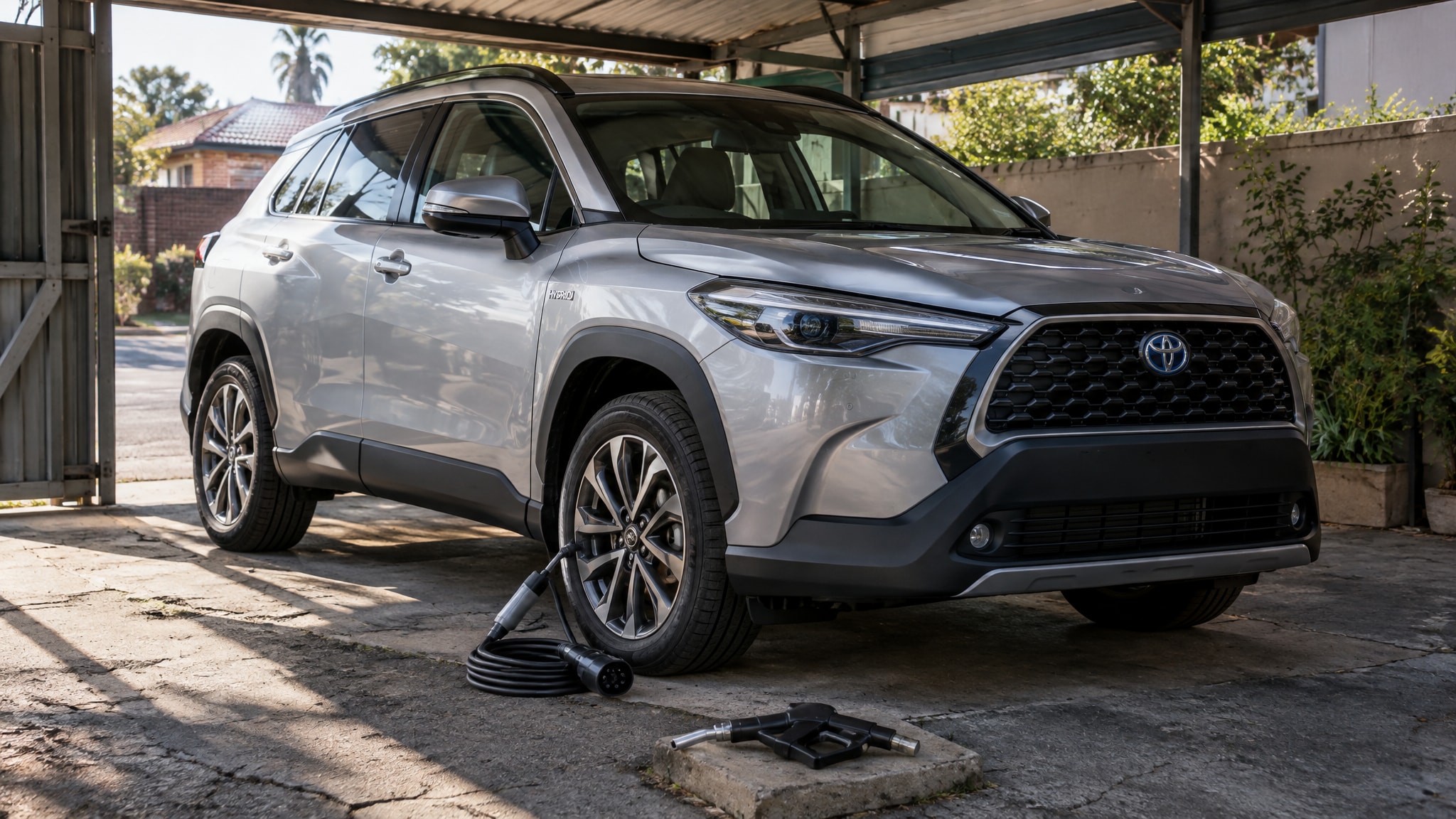
Hybrids have gone from curiosity to a serious option on the used market. If you're weighing one for your next vehicle, here is how we see it after 28+ years of combined motor industry experience.
Why hybrid cars are taking off in South Africa
New energy vehicle sales to September 2026 reached 22,389 units, already 34% above the whole of 2025. That category is broader than hybrids alone, but it shows where buyers are heading, and fuel cost is a big part of the reason.
Petrol at around R30/l makes every long commute feel expensive, so a car that sips less is an easy argument to accept. If you only want a battery-electric car, our guide to electric cars and cheaper EV options is the better place to start.
Mild, full and plug-in hybrid cars explained simply
The three types differ in how much work the electric side does.
- Mild hybrid: a small electric motor assists the petrol engine, smoothing starts and trimming fuel use. It doesn't drive the car on its own.
- Full hybrid: the car can move short distances on electric power alone, and it recharges its battery as you brake and drive. You never plug it in.
- Plug-in hybrid: a larger battery that you charge from a socket, so shorter trips can run largely on electricity, with the petrol engine behind it for longer journeys.
Which type suits which driver
A full hybrid suits the city commuter, because stop-start traffic is where the electric motor does most of its work. A mild hybrid is the gentlest step if you want modest savings without changing any habits.
Long-distance travellers should look at full hybrids too, since they need no charging stops. A plug-in only makes sense if you can charge at home or at work, because without regular charging you are simply carrying a heavy battery around.
Real fuel savings: a worked example against petrol at about R30/l
The sums are simple, and you should always run them with your own figures rather than trust a brochure number. Below are round assumptions to show the method, not measured results.
Run the numbers for your own driving
Take 1,500 km a month. Suppose a petrol car uses 9 l/100 km and a comparable hybrid uses 6 l/100 km.
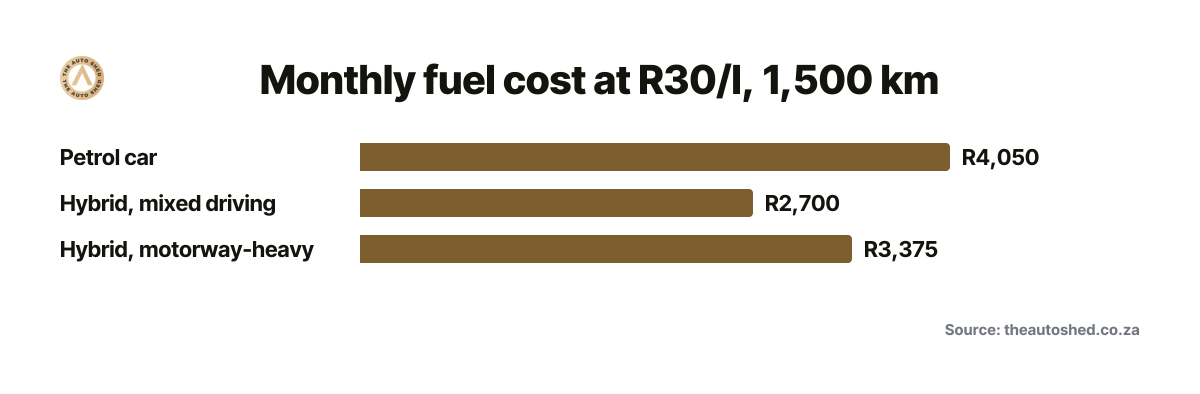
- Petrol car: 1,500 km ÷ 100 × 9 = 135 litres. At R30/l, that is R4,050 a month.
- Hybrid: 1,500 km ÷ 100 × 6 = 90 litres. At R30/l, that is R2,700 a month.
- The difference is R1,350 a month, or R16,200 over a year.
Swap in the consumption figures for the exact cars you're comparing. You can calculate your own fuel expenses with our fill-up calculator, and it's worth keeping an eye on where the petrol price is heading, because every rand added to a litre widens the gap.
When the saving is smaller than you expect
A hybrid is not a guaranteed win for everyone. On open motorway at a steady speed, the petrol engine does most of the work and the electric motor has little chance to help.
Say the same hybrid uses 7.5 l/100 km on a motorway-heavy month. That is 112.5 litres, or R3,375, so the saving drops to R675. If most of your kilometres are on the N1, the case for a hybrid rests on other things, such as refinement, and not on fuel alone.
Buying a used hybrid: battery life, warranty and what to check
With a used hybrid, the battery is the part that deserves your attention. It is also the part buyers worry about most, usually more than it warrants, provided you check it properly.
Battery life and warranty
Toyota hybrid batteries carry a benchmark warranty of 8 years/195,000 km. We treat that figure as a useful yardstick, not a promise on any particular car.
Cover depends on the specific vehicle, its age and mileage, and how it transfers to a second owner. Ask for the terms in writing for the exact car in front of you. We won't quote a battery lifespan, because the honest answer is that condition matters more than a number.
Our pre-purchase checklist
Every vehicle we sell is Autoshed Approved, with a Dekra roadworthy inspection and a verified service history. For a used hybrid, we’d tell any buyer to insist on the following:
- Battery health report: an actual reading of the battery's condition, not a verbal assurance.
- Full service history: hybrids reward regular servicing, and gaps tell their own story.
- Dekra inspection: see what a Dekra report covers before you decide.
- VIN history check: run a VIN check to confirm the car's past matches the seller's story.
If a vehicle isn't good enough for our family, it isn't good enough for yours. Ask us for any of these on a car in our stock, and we’ll show you.
Browse our current stock at The Auto Shed, including mild-hybrid models such as the Land Rover Defender P400. Looking for a specific hybrid? WhatsApp us on 077 600 5558 and we’ll help you find one. We arrange finance through the major banks, accept trade-ins and deliver nationwide.
Frequently asked questions
Do I need to plug in a hybrid car?
Only a plug-in hybrid needs charging from a socket. Mild and full hybrids look after their own batteries as you drive.
Is a used hybrid battery covered by warranty?
It can be. Toyota's benchmark is 8 years/195,000 km, but cover depends on the specific car and how it passes to a second owner, so confirm the terms in writing before you buy.
Will a hybrid save me money if I drive mostly on the motorway?
Less than in the city, because the petrol engine does most of the work at steady speed. Work through the sums with your own consumption figures to see whether the saving justifies the purchase.