
Most of us only see the cost to fill up when the pump clicks off and the screen shows the total. By then it is too late to plan for it. The sum is simple, though, and once you know it you can price a tank, a short trip or a whole month of driving before you leave the driveway.
We have spent 28+ years of combined experience in the motor industry, and fuel is a question we hear from almost every buyer. This guide explains how the numbers work, what pushes them up, and how to weigh fuel use when you choose your next vehicle.
The Simple Formula for the Cost to Fill Up a Tank
The arithmetic is one multiplication. The useful part is knowing which numbers to feed into it and what to leave out.
Tank size multiplied by price per litre
Take the tank capacity in litres and multiply it by the pump price per litre. That gives you the cost to fill up from completely empty.
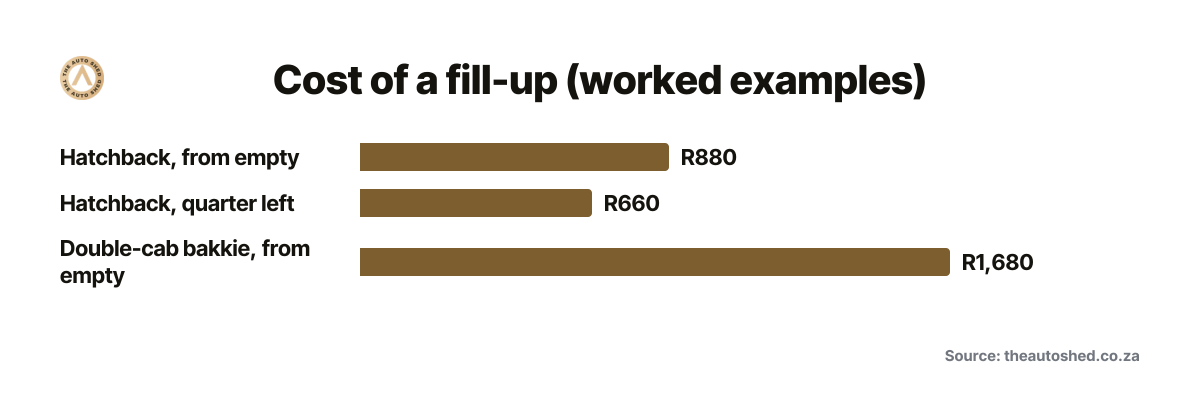
Say a small petrol hatchback has a 40-litre tank and fuel costs R30 a litre. A full tank from empty is 40 × R30, which comes to R1,200.
Now take a double-cab diesel bakkie with an 80-litre tank and diesel at R31 a litre. The same sum gives R2,480, more than twice the hatchback's bill, simply because the tank holds twice as much.
Pump prices change every month, so swap in today's price before you rely on the result.
Why an empty-to-full fill is rarely what you actually pay
Almost nobody lets the needle touch empty. Most of us top up at a quarter or half a tank, so the amount of fuel you actually buy is smaller than the tank size.
If the hatchback above still has a quarter of its fuel left, you buy 30 litres, not 40. That is 30 × R30, or R900.
The empty-to-full figure is a ceiling, not your usual bill. Use it for the worst case, and use the litres you actually pump for everyday budgeting.
What Changes the Price of a Full Tank
Three things move the total: how big the tank is, what goes into it, and where you buy it. The first matters most, and the other two are smaller but real.
Tank capacity across small cars, SUVs and bakkies
A small hatchback carries a modest tank. A large SUV carries more, and a double-cab bakkie usually carries the most, because it is built for distance and loads.
That is why the same pump price produces such different totals at the till. A bigger tank is not a bigger fuel bill every week, however, because a big vehicle that is filled less often can cost about the same per month as a small one filled more often.
Your owner's manual lists the exact capacity for your vehicle, so check it rather than guessing from the size of the car.
Petrol, diesel and octane grades
Petrol and diesel are priced separately, and each moves on its own in the monthly adjustment. Within petrol, 95 and 93 octane also carry different prices.
Use the grade your manual specifies. Paying for a higher octane than the engine needs buys you nothing, and running a lower grade than it asks for can cost you in performance and efficiency.
Diesel engines often return fewer litres per 100 km, so a diesel can cost less per kilometre even when the price per litre looks similar. We look at that trade-off in more detail in our piece on hybrid versus diesel running costs.
Coastal versus inland pricing
Fuel inland, including Gauteng, typically costs a little more per litre than at the coast, because it has to be transported further. If you live in Centurion and drive to Durban or Cape Town, the price you pay will change along the way.
The gap is small on a single fill. Over a year of regular driving it adds up, so use your local price in the formula and not a figure you saw somewhere else.
How Much Petrol Does a Short Drive Use?
You need two numbers: your car's consumption in litres per 100 km, and the distance you drive. Multiply them, then divide by 100.
Estimating fuel for a 20-minute drive
A 20-minute drive covers a very different distance depending on where you are. In stop-start suburban traffic you might manage 10 km. On a clear stretch of the N1 you could cover 30 km or more.
Suppose your car uses 8 litres per 100 km and the drive is about 13 km. That is 8 × 13 ÷ 100, which is just over a litre of petrol. At R30 a litre, the trip costs about R31.
Your own figure will differ, because consumption changes with traffic, speed and how warm the engine is. Short trips from a cold start burn proportionally more than the same distance on a long run, so treat the answer as a fair estimate and not a promise.
Your trip computer shows your average consumption, which is the number to use in the sum.
Is there really a '30-minute petrol rule'?
You will hear people say you should never let the tank fall below the point where you have 30 minutes of driving left. It is a rule of thumb, not a fact, and no manufacturer or regulator publishes it.
The idea behind it is sound. Running very low is risky, because you may not reach a station and a car that runs dry can pick up debris from the bottom of the tank.
Rely on it only as a prompt to refuel early. Your car's range display and the fuel gauge give you better information, and neither uses a time-based rule.
Turning a Fill-Up Into a Cost Per Kilometre
A tank total tells you what leaves your wallet at the pump. A cost per kilometre tells you what each trip costs, and that is the number that helps you compare vehicles and budget for work travel.
Using litres per 100 km to price every trip
Divide your consumption by 100 to get litres per kilometre, then multiply by the pump price. The hatchback at 8 litres per 100 km uses 0.08 litres a kilometre, so at R30 a litre each kilometre costs R2.40 in fuel.
The bakkie at 11 litres per 100 km and R31 a litre comes to R3.41 a kilometre.
Once you have that figure, any journey is quick to price. Multiply the distance by the rate, and you have the fuel cost of the trip before you set off.
Does a flat per-km reimbursement rate cover your fuel?
Sometimes. A flat rate covers fuel only if your consumption is modest and your fuel price is close to the figure the rate was built on.
Drive a thirsty SUV or a loaded bakkie and your fuel alone can eat most of the allowance. A flat rate also has to cover tyres, servicing, insurance, licensing and depreciation, so fuel is only one part of what it is meant to pay for.
Work out your own cost per kilometre and compare it with the rate you receive. For the wider picture, we have set out what a car really costs to run each month.
Why Real-World Fill-Ups Cost More Than the Brochure Suggests
Brochure consumption figures come from standard test conditions. Your driving rarely matches them, and in our experience the gap comes from two places: how the vehicle is driven and how well it is maintained.
Driving style, load, aircon and tyre pressure
Gauteng highways reward steady driving and punish speed. Fuel use climbs quickly as you push past the legal limit, so a hurried trip to Johannesburg costs more than a relaxed one.
Several other things add to the bill:
- Load and towing. A loaded bakkie, a roof rack or a trailer all make the engine work harder.
- Aircon. Running it hard in summer raises consumption, particularly in slow traffic.
- Tyre pressure. Under-inflated tyres drag on the road and use more fuel with every kilometre.
- Hard acceleration. Rapid starts and late braking waste the momentum you built up.
Check your tyre pressures monthly against the figures on the door pillar or in the manual. It takes a few minutes and costs almost nothing.
Mechanical faults that quietly burn fuel
Faults rarely announce themselves. They show up as a slow rise in litres per 100 km, which is easy to miss when you fill up on the same day each week.
When a vehicle reaches us for an Autoshed Approved inspection, three things come up again and again: worn or badly matched tyres, tired batteries and aircon systems that no longer cool properly. Each one nudges consumption up.
A weak battery makes the alternator work harder to recharge it, and that load comes out of the engine. If you suspect yours is on its way out, read the warning signs of a failing battery. A struggling aircon compressor also drags on the engine, and our notes on aircon problems and safe checks explain what to look at first.
A cheap fill-up is not proof that a vehicle is a good buy. A well-prepared, properly maintained vehicle uses fuel as efficiently as it was designed to, and that is what we check for before a car ever reaches our floor.
Smart Ways to Pay Less Each Time You Fill Up
You cannot change the pump price, but you control how much fuel you burn and when you buy it. Neither calls for anything dramatic.
Habits that stretch a tank
Fuel prices adjust once a month, so it pays to know what is coming. Our guide on what to expect from the next petrol price adjustment shows how to read the signals, and filling up just before a rise saves a little on each litre.
Beyond timing, a few habits make a steady difference:
- Keep the tank above a quarter. Driving on the fumes risks a breakdown and does nothing for your wallet.
- Drive smoothly, with gentle acceleration and early lifting off the throttle.
- Remove roof racks and heavy items you do not need.
- Use a fuel retailer's loyalty or rewards programme if you already stop there regularly. The savings are modest, but they cost you nothing.
These habits will not turn a thirsty vehicle into an economical one. They trim the bill, and the engine and body still set the limit.
When a different vehicle makes sense
Sometimes the honest answer is that the vehicle is the problem. If you cover big distances in a large engine you do not need, a smaller or more efficient car may pay for itself over a few years. We explore whether downsizing helps beat fuel prices for exactly that situation.
If you tow, carry loads or travel rough roads, a bakkie or SUV is still the right tool, and the better step is to keep it in good condition.
Factoring Fuel Into Your Next Vehicle Choice
Fuel economy is one line in the total cost of owning a vehicle, alongside the purchase price, finance, insurance, servicing and resale value. A car that sips fuel but needs expensive repairs is not a saving.
Our rule is simple: if a vehicle isn't good enough for our family, it isn't good enough for yours. Every vehicle we sell goes through our Autoshed Approved process, so the tyres, battery, aircon and engine are checked before you consider the fuel figures. Over 70% of our business comes from repeat customers and referrals, and that only happens when what we tell you holds up on the road.
Questions to ask about fuel use before you buy
Put these to any seller, including us:
- What consumption has the vehicle returned in real driving, not just on the brochure?
- What is the tank capacity, and what range does that give you on your usual routes?
- Which fuel and octane grade does it need?
- What condition are the tyres, battery and aircon in?
- Does the vehicle suit the load, towing and distance you actually need?
Use the formulas above to turn the answers into rand per kilometre, then compare vehicles on that figure.
If fuel costs are part of your decision, you are welcome to browse our current stock or talk to our team. We will give you honest advice, with no pressure to buy.
Frequently asked questions
How much will it cost me to fill up my car?
Multiply your tank capacity in litres by today's price per litre. A 40-litre tank at R30 a litre is R1,200 from empty, while an 80-litre tank at R31 a litre is R2,480. Most people refuel before the tank is empty, so your real bill is usually lower.
How much petrol does a 20-minute drive use?
It depends on the distance you cover and your car's consumption. At 8 litres per 100 km and about 13 km, you use just over a litre, or about R31 at R30 a litre. Your trip computer's average consumption gives a closer figure for your own car.
What is the 30-minute petrol rule?
It is a rule of thumb that you should refuel before you have less than about 30 minutes of driving left. It is not an official standard. Use it as a reminder to fill up early rather than a precise measure of what remains in the tank.
Does a flat per-kilometre rate cover fuel cost?
Only if your consumption is modest. Multiply litres per kilometre by the pump price to get your own fuel cost per kilometre, then compare it with the rate. A flat rate also has to cover servicing, tyres, insurance and depreciation, so a thirsty vehicle can use most of it on fuel alone.