
Second-Hand Luxury Car Finance Deposit: How Much Is Needed?
, 9 min read
- luxury car deposit south africa
- used car finance deposit amount
- how much deposit for car loan sa
- premium vehicle financing options
If you are shopping for a premium used car or bakkie, the deposit is usually the first number you want pinned down. It is also the one nobody can quote you in the abstract.
Most advice online is written for cheaper cars, where a deposit is a modest sum. On a premium vehicle, the same approach means a much bigger cheque. We have spent 28+ years in the motor industry, and most of our business comes from repeat customers and referrals, so we explain deposits the way we would to a family member: plainly, and with the monthly repayment in view.
How the finance deposit works on a second-hand luxury car
There is no fixed deposit for a second-hand luxury car in South Africa. The amount follows four things: the price of the vehicle, the length of the loan, your credit profile and the lender's affordability assessment.
That last point is not optional. The National Credit Act requires a credit provider to assess whether you can afford the repayments before granting credit, and that assessment is one reason the deposit depends on your circumstances rather than a single rule. Two buyers looking at the same car can be asked for different amounts.
The trade-off is simple. A bigger deposit lowers your monthly instalment and the total interest you pay over the loan. A smaller deposit keeps more cash in your hands, which matters if you want a buffer for insurance, servicing or your business.
Neither is the "right" choice for everyone. A deposit also does not buy approval: a large one will not rescue an application that fails the affordability check, and this article cannot give you a number before a lender has looked at your profile.
Why premium pricing changes the luxury car deposit in South Africa
Premium pricing changes the maths in two ways, and both push the deposit up. You may not notice either until the quote arrives, so it helps to understand them first.
Why a percentage deposit means more rand on a premium price
A deposit set as a share of the price is a bigger sum in rand the higher the price climbs. A buyer who is comfortable putting down a tenth of a mid-range hatchback is not putting down the same rand amount on an executive sedan or a double-cab bakkie.
This catches out many professionals who are used to the rule of thumb from their first car. The percentage may feel familiar, but the rand figure is a different conversation, and your savings need to be able to carry it without leaving you stretched.
How lenders value a premium model
Lenders do not simply accept the asking price. They work from their own valuation of the vehicle, and that valuation can sit below what the car is advertised for. The difference widens the gap your deposit has to cover.
Premium SUVs, executive cars and bakkies can hold their value quite differently from one another, and from one year to the next. A lender looks at how a particular type of vehicle has traded, not at how good the car looks on the showroom floor. We do not promise resale values for any vehicle, and you should be wary of anyone who does.
Lenders also often apply age and mileage limits to older stock, so a well-kept older premium car can be harder to finance than its condition suggests. If you are weighing a newer car with higher mileage against an older one with lower mileage, read how mileage compares with age on a used car before you settle on a shortlist.
Using a trade-in or savings to build your deposit
You do not need to find the whole deposit in cash. Savings, cash from selling your current car and the equity in a trade-in can all go towards it.
Trade-in equity as part of your deposit
Trade-in equity is what your car is worth minus what you still owe on it. If your car is valued above the settlement figure, the difference goes towards your deposit, and you can walk in with less cash than you expected.
Selling your car privately and putting the proceeds down is the other route. It can take longer, but some owners prefer it. We offer vehicle financing alongside trade-in valuations and vehicle buy-back, so a deposit conversation with us can include your current car as well as cash.
When a trade-in leaves a negative equity gap
A buyer trading in a car with a finance balance still owing only gains deposit equity if the car is worth more than that balance. If it is worth less, the shortfall has to be covered before any equity can go towards the deposit.
In other words, a trade-in with more owing than it is worth reduces what you can put down, and in some cases it adds to what you must find. That is a common situation, not a failure on your part. Our piece on negative equity and your options sets out the choices.
The practical next step is a trade-in valuation. Once you know the car's value and your settlement figure, the deposit stops being a guess.
Budgeting for the monthly costs beyond the deposit
The deposit is only part of what leaves your account in the first month. Upfront fees, such as an initiation fee, and the first insurance premium can sit on top of it. If you spend every spare rand on the deposit, those costs arrive when you have nothing left to meet them.
Running a premium car also costs more month to month. Servicing and parts on premium makes often cost more than on mainstream ones, and fuel, tyres and licensing are part of the picture too. We have set out what a car really costs to run each month if you want to build a fuller budget.
None of this is a reason to hold back. It is a reason to keep a cushion, so that the deposit you choose is one you can live alongside.
Comprehensive insurance and tracking requirements
Lenders usually require comprehensive insurance on a financed vehicle, and some also ask for a tracking device. Both protect the car you are still paying off, and both carry a cost.
Get an insurance quote on the specific vehicle before you commit. The premium on a premium vehicle can differ noticeably from what you pay on your current car, and it belongs in your monthly figure from day one.
Premium vehicle financing options and how your deposit fits
Finance for a premium used car is rarely one-size-fits-all. We offer finance alongside trade-ins and buy-back, which means the deposit can be discussed around your monthly budget instead of the other way round. You can see the vehicle finance options at The Autoshed on our site.
Working backwards from your monthly car loan budget
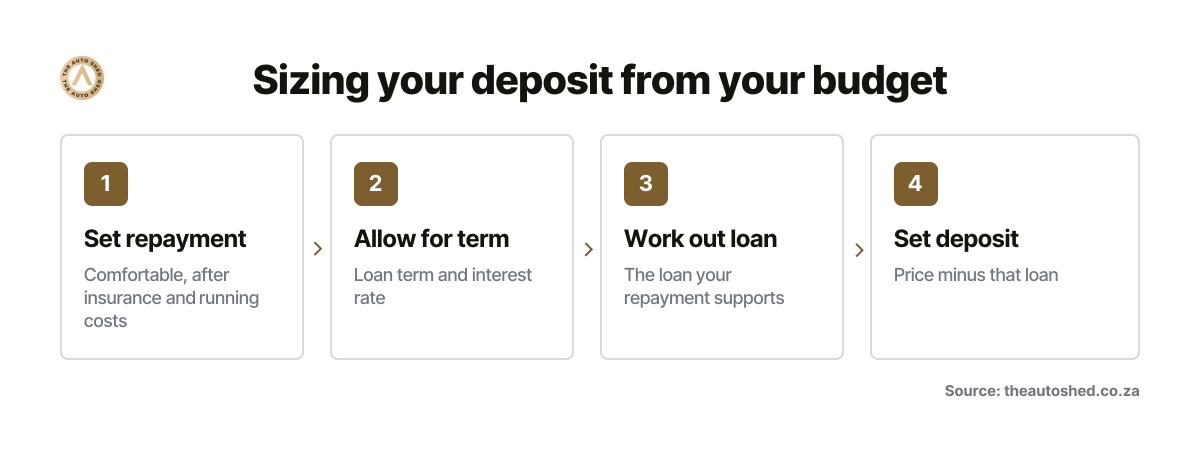
Working backwards from a comfortable monthly repayment is the most practical way to size a deposit. It answers how much deposit for a car loan in SA makes sense for you far better than any rule of thumb. Try it in this order:
- Decide the monthly repayment you can carry comfortably, after insurance and running costs.
- Allow for the loan term and the interest rate, which together set how much each rand borrowed costs you. Our guide to car finance interest rates shows how the rate moves the figure.
- Work out the loan that repayment supports.
- Set your deposit at the difference between that loan and the price of the car.
If the deposit that comes out is more than you want to part with, you have three levers: a longer term, a different vehicle, or a bigger trade-in. A longer term lowers the instalment but raises the total interest, so weigh that carefully.
What a lower deposit depends on
A lower deposit is possible for some applicants, but it depends on approval. We will not tell you in advance that a low or zero deposit is available, because that is the lender's decision and it rests on your credit profile and affordability.
What helps your case is a clean credit record, a repayment that fits comfortably within your income, and a vehicle that falls within the lender's age and mileage limits. If you want to understand the checks behind the decision, read how vehicle finance approval works in South Africa.
Check the vehicle and its finance history before you pay a deposit
A deposit is real money, and it should only go down on a car with a clean history. Before you pay, ask to see the vehicle's history and have it checked.
Each vehicle we sell is vetted through our Autoshed Approved inspection process, and we are open about its history. If a vehicle isn't good enough for our family, it isn't good enough for yours. That openness is how you protect the money you put down, whoever you buy from.
Confirm no finance is owing on the car
A car that still has finance owing to another lender is not yours to buy outright, whatever the seller says. Confirm that no finance is owing, and get that confirmation before the deposit leaves your account, not after.
It is a quick step that spares you a very slow problem. Our guide on how to check for finance owing before you buy walks through it.
Plan your deposit and start the conversation with us
If you would like to talk through a deposit around your monthly budget, we are happy to do it with no pressure. Trade-in details are welcome, and we can include your current car in the conversation from the start. You can get in touch about your deposit plan whenever it suits you.
It helps to have these to hand:
- The monthly repayment you are comfortable with
- The savings you are happy to put towards a deposit
- The make, model, year and mileage of any car you would like to trade in
- Any finance balance still owing on that car
- The vehicle, or type of vehicle, you have in mind
Frequently asked questions
Is there a minimum deposit for a second-hand luxury car in South Africa?
There is no single minimum that applies to every buyer. The amount follows the vehicle price, the loan term, your credit profile and the lender's affordability assessment. A lower deposit is possible for some applicants, but it depends on approval.
Can I use my current car as a deposit?
Yes, the equity in your current car can go towards the deposit. Equity is what the car is worth minus what you still owe on it. If you owe more than it is worth, the shortfall reduces what you can put down.
Why does the lender's valuation matter for my deposit?
Lenders work from their own valuation, which can be lower than the asking price. The difference widens the gap your deposit has to cover. A larger valuation gap on a premium car therefore means a larger sum in rand.
What costs come on top of the deposit?
Fees such as an initiation fee and your first insurance premium can sit on top of the deposit. Lenders usually require comprehensive insurance, and some also ask for a tracking device. Servicing and parts on premium makes often cost more as well.
How do I work out the right deposit for me?
Start with the monthly repayment you can carry comfortably, then allow for the loan term and interest rate. That gives you the loan the repayment supports. Your deposit is the difference between that loan and the price of the car.