

A test drive is your best tool for separating a genuine bargain from an expensive liability, yet many buyers treat it as a formality rather than a diagnostic exercise. Knowing what to look out for on a test drive means moving past the excitement of a premium badge and systematically checking mechanical integrity, safety functionality and daily liveability. Our Autoshed Approved process handles the mechanical vetting, but your own assessment still matters. Only you know whether a vehicle suits your driving environment and your family's needs.
This guide walks through a structured approach to evaluating premium used vehicles, so you gather real evidence rather than relying on hope or a seller's word.
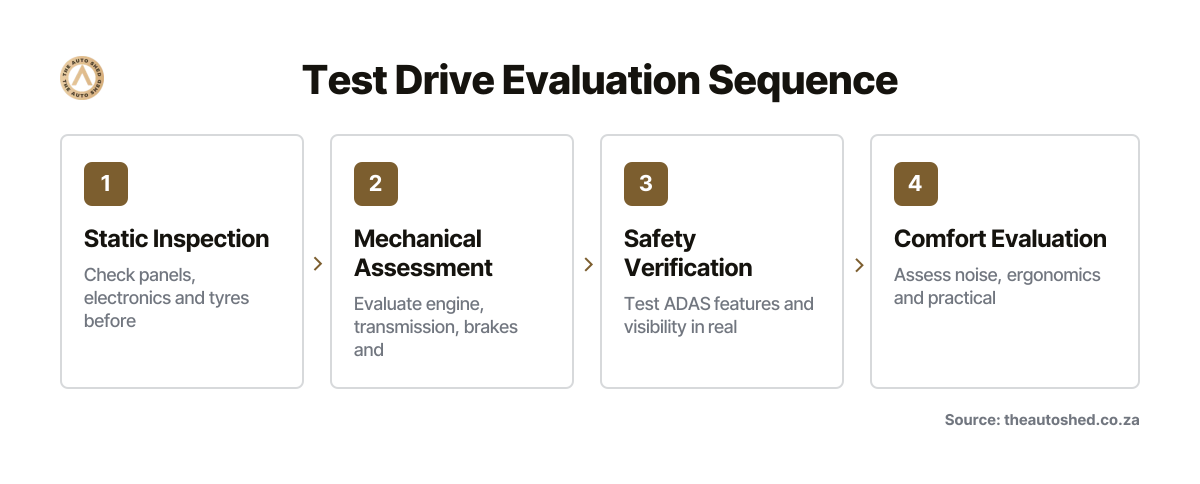
Pre-Drive Static Checks Before You Start the Engine
The most telling evidence of a vehicle's history often shows up before the engine turns over, if you know where to look. These static checks set a baseline: they either back up what the seller has told you, or they raise questions about neglect nobody mentioned.
Exterior Condition and Panel Gaps
Walk around the vehicle in natural daylight and check paint consistency across adjacent panels. Mismatched shades or an orange-peel texture usually mean a respray after accident damage. Run your hand along the panel gaps, too. Uneven spacing between doors, bonnet and bumpers points to misalignment from repairs that weren't done to manufacturer standard. Tyre wear is worth a close look as well, since uneven tread depth on the same axle suggests suspension problems or alignment neglect that rotation alone won't fix.
Check all exterior lights and lenses for moisture inside or yellowing plastic, both signs of age or poor storage. Open the bonnet and check the oil, coolant and brake fluid levels and condition. Milky oil, oily coolant or dark, low brake fluid all point to problems worth investigating.
Interior Wear and Control Functionality
Sit in the driver's seat and work every switch, dial and touchscreen to check it responds properly. Intermittent faults in window regulators, seat motors or infotainment systems are expensive to diagnose later. Compare upholstery wear against the odometer reading. Heavy bolster wear on a low-mileage example can mean city-heavy use or previous commercial service, and the mechanical components will usually tell the same story. Test every climate control zone individually, because dual-zone failures in luxury vehicles often mean pulling the dashboard apart to fix.
Check that all dashboard warning lights come on during the ignition self-test and go off once the engine starts. A bulb removed to hide a persistent fault is a serious red flag.
Evaluating Mechanical Health During the Test Drive
With 28+ years of combined motor industry experience, we've learned that a thorough test drive separates genuine value from costly compromise in ways a static inspection simply can't. This is the part that demands your full attention, because it's your senses picking up how mechanical systems have aged under real driving conditions.
Engine Response and Transmission Behaviour
Start the engine cold if you can, and listen for timing chain rattle, lifter tick or turbo whine that fades once oil pressure builds and things warm up. Run through the full rev range in each gear and watch for flat spots, hesitation or misfires, which point to fuel delivery problems, a failing ignition coil or boost leaks on turbocharged engines. Pay attention to how the transmission shifts under light throttle and under load. Harsh engagement, delayed shifts or torque converter shudder usually mean degraded fluid, worn solenoids or a clutch pack on its way out, and that needs a specialist.
Luxury sedans and SUVs need their own checks: cycle through the ride height settings and damping modes to confirm the air suspension compressor and air bags are healthy, since this electronics ages differently to the mechanical parts underneath it.
Braking Performance and Steering Feedback
Brake progressively at a few different speeds and pay attention to pedal feel and stopping power. Any judder through the wheel points to warped discs or pad material transferred onto the rotors. Listen too for grinding, squealing or clunking on deceleration, which tells you whether you're looking at a routine pad change or something more serious like a caliper or hub bearing. Check the steering for play, vagueness or uneven resistance, early signs of worn rack bushings, tie rod ends or a power steering pump starting to fail.
Test braking on a couple of different surfaces to make sure the ABS modulates properly without pulling the car sideways under hard braking.
Suspension Comfort Over Varied Surfaces
Look for speed bumps, potholes and rough patches of road deliberately, because smooth tarmac hides a lot. Listen for clunks, creaks or metallic rattles that point to worn bushings, ball joints or damper top mounts. Watch how the car settles after a compression, too. Excessive bounce or slow rebound confirms the shocks are worn out even if there's no visible leak on the damper body. Bakkies and 4x4 SUVs like the Ford Ranger or Toyota Fortuner need extra attention here: check load-bed condition on bakkies and engage low-range gearing and diff locks where it's safe to, to confirm the transfer case and actuators work as they should.
Watch whether the steering returns to centre naturally after a corner. If it doesn't, you could be looking at binding ball joints or strut mounts, or alignment thrown out by previous impact damage.
Testing Safety Features and Driver Assistance Systems
Modern premium vehicles carry safety technology that degrades silently over time, so you need to verify it actively rather than trust a dashboard light or a seller's say-so. Calibration drift, a dirty sensor or a software glitch can quietly take these systems offline, right when you'd need them most.
Active Safety Calibration in Real Conditions
Engage adaptive cruise control on the open road and check it maintains following distance and decelerates smoothly. Erratic braking or a failure to resume speed points to a misaligned radar sensor or an obstructed camera. Test lane-keeping assist where the lines are clear, and watch for jerky corrections or delayed warnings, both signs the camera needs recalibrating or a steering angle sensor has failed. At low speed, activate the parking sensors and reverse camera and check the distance readout is accurate and the alerts sound properly. Rear-end knocks damage these without leaving any obvious external mark.
Blind spot monitoring should trigger reliably whenever a vehicle enters the detection zone during a lane change, so check that aftermarket tinting or bumper repairs haven't thrown off sensor positioning and dulled it.
Visibility and Blind Spot Assessment
Adjust the mirrors and seat to your own build before you judge visibility. Factory ergonomics are set up for an average frame, and that can leave real blind spots for a taller or shorter driver. Check rearward vision through the rear window and the mirrors from your normal seating position, and notice whether headrests, roof pillars or the cargo area block the view that matters for your usual passengers or loads. Look over the windscreen too, for chips, scratches or delamination inside the wiper sweep. These seem minor in daylight but can badly affect night driving.
Confirm the automatic wipers and headlights switch on appropriately as light or rain changes. A failed sensor here is a real safety gap during the sudden weather shifts common on South African roads.
Assessing Comfort and Daily Liveability
A premium used vehicle should still feel as refined as its badge suggests, whatever its age, so comfort deserves the same weight as the mechanical checks. This is where you find out whether the car actually fits your life, not just the spec sheet.
Noise Levels and Cabin Refinement
Drive at highway speed with the audio off and listen for wind noise, tyre roar or mechanical drone, any of which can point to worn seals, an exhaust leak or bearing wear that music would normally mask. Listen for rattles from trim panels, the sunroof or door cards over rough surfaces too; these often mean assembly quality has slipped or the car's been apart for a repair and not put back together properly. Check the climate control across every vent and setting, and note any uneven airflow or slow response, which usually means a failing blend door actuator or a system low on refrigerant.
A quiet cabin matters more than it sounds. Fatigue on a long drive tracks closely with how much noise makes it into the car, so this is a functional point, not a luxury.
Seating Ergonomics and Space Practicality
Take your time adjusting seat position, lumbar support and the steering wheel reach until the driving posture feels right. A mismatch here causes the kind of chronic discomfort that no amount of mechanical soundness fixes. If it applies to you, bring the actual child seat and test it in the rear: check the ISOFIX anchors are reachable and the seat contours work with your own restraint system, not just any seat. Open the boot and every storage compartment and measure them against what you actually need to carry, checking that split-folding seats move smoothly and the load floor sits level once folded.
Try getting in and out of every seat. Ground clearance and door aperture affect daily use far more than any brochure figure does.
Red Flags That Warrant Walking Away
Some faults compromise safety or mechanical integrity to a degree no price can justify, however attached you've become to the car. Spotting these early saves you time, money and, in some cases, real danger.
A warning light the seller waves off as "just a sensor" instead of diagnosing properly tells you something about either their honesty or their competence, and neither is a good sign for the rest of the deal. Heavy exhaust smoke, whatever the colour, points to major engine wear, turbo failure or coolant getting where it shouldn't, and that's rebuild money, well past what a used-car budget should have to stretch to. Clutch slip under load, a transmission that slips between gears, or diff whine all say the drivetrain is near the end of its life, even if it's still getting you through the test drive.
If a seller won't allow an independent inspection, or tries to cut your test drive short, that usually means there's something they'd rather you didn't find until after you've paid.
No deal is worth gambling on mechanical integrity or safety. Repair costs on a neglected premium vehicle climb far past whatever you saved at purchase.
How Our Autoshed Approved Inspection Supports Your Test Drive
Every vehicle we offer goes through our Autoshed Approved inspection process first, which deals with mechanical and cosmetic issues before a test drive ever happens. That means your test drive can focus on whether the car fits you, not on hunting for basic mechanical problems. It covers brake system condition, suspension components, electronic functionality and fluid service status across every major system. Over 70% of our business comes from repeat customers and referrals, which we put down to transparent preparation and honest advice rather than one-off sales that leave the buyer to do all the checking.
Our family works on one principle: if a vehicle isn't good enough for our family, it isn't good enough for yours. That means we turn away stock that doesn't meet our standard, whatever the margin on it. It also means your test drive can focus on fit and feel, because you're assessing a known-good car, not hoping to catch a problem before it becomes yours. Have a look at our current premium inventory to see vehicles prepared to this standard for yourself.
Next Steps After a Successful Test Drive
Ask for full service records and verification documents straight after a test drive goes well, so you can confirm the maintenance claims and set a baseline for future servicing. If anything gave you pause during the drive, get an independent mechanical opinion before you go further; a second set of eyes is worth it on a purchase this size. Talk through financing, trade-in value and warranty cover while the test drive is still fresh in your mind, so you can compare it fairly against anything else you're considering.
Keep the momentum going by dealing with any outstanding questions straight away rather than letting doubt creep in over a car that actually suited you. Understanding buying from a dealer versus private seller puts the value of a professionally prepared car in context against a private sale, where you carry more of the risk yourself. For a closer look at what proper preparation actually involves, our certified pre-owned inspection checklist sets out exactly what thorough vetting covers beyond the basic mechanical checks.
Knowing what to look out for on a test drive is one part of the due diligence that helps South African buyers avoid costly mistakes in the premium used vehicle market.
Frequently Asked Questions
What are the six essential pre-drive checks before starting a used car?
Inspect panel gaps and paint consistency for accident repair evidence, test all electronic switches and infotainment responsiveness, examine tyre wear patterns for alignment issues, verify dashboard warning lights function correctly during ignition self-test, check fluid levels and condition under the bonnet, and assess interior wear against stated mileage for usage pattern discrepancies.
How do I verify driver assistance systems actually work during a test drive?
Actively engage adaptive cruise control on open road to confirm following distance maintenance, test lane-keeping assist under clear markings for smooth steering intervention, activate parking sensors while manoeuvring to verify accurate distance alerts, and check blind spot monitoring triggers reliably during lane changes rather than assuming functionality from dashboard indicators alone.
What mechanical red flags mean I should walk away from a used car?
Persistent warning lights dismissed without diagnosis, excessive exhaust smoke indicating major engine wear, clutch or transmission slipping under load, and seller refusal to permit independent inspection all represent fundamental integrity compromises that no price discount can justify for premium used vehicles.
Which comfort factors matter most for long-term ownership satisfaction?
Highway noise levels with audio off reveal seal and bearing condition, seating adjustability must achieve comfortable posture without compromise, child seat compatibility requires physical testing with your equipment, and climate control effectiveness across all zones confirms actuator health in aging luxury vehicle systems.