
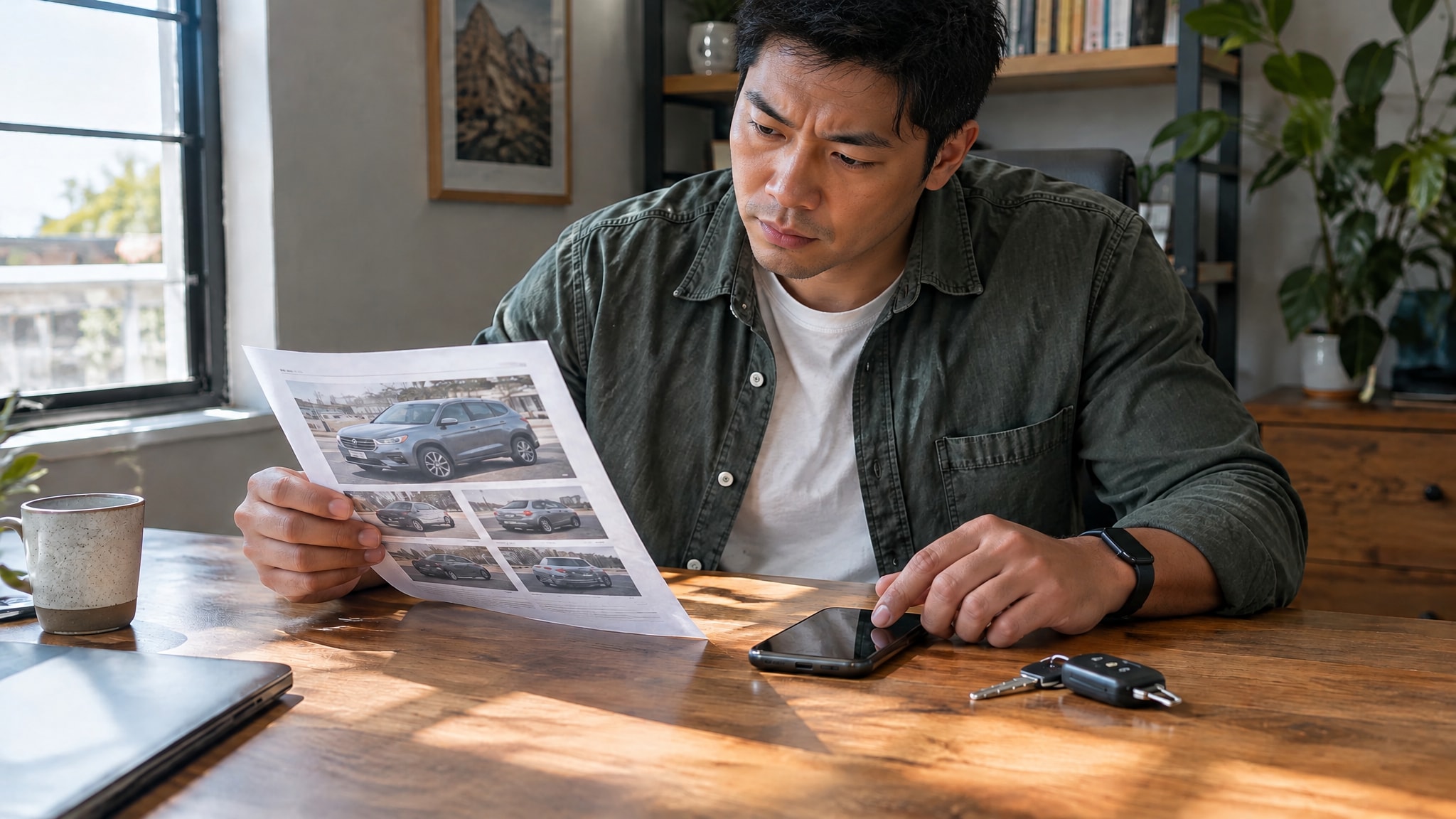
Most people who lose money to a fake car advert are not careless. They are busy, they have done their homework, and the scammer has simply made the offer feel normal. Online car scams work because a fake listing costs almost nothing to create, while a genuine bargain feels rare enough to chase.
We have spent 28+ years of combined experience in the South African motor industry, and we have watched the same few tricks come round again and again. This guide sets out how they work, how to spot them, and what to do if one gets through. It applies whether you are buying or selling.
Why Online Car Scams Keep Catching Sensible People
Marketplaces, social media groups and classifieds all let anyone post a vehicle in minutes. Photos can be lifted from a real advert, a phone number can be bought cheaply, and a profile can look established for the price of a few fake reviews.
Scammers then lean on two things: urgency and trust. "Another buyer is on his way with cash" shuts down careful thinking, and a friendly, chatty seller makes you feel rude for asking for paperwork.
Buyers and sellers get caught in different ways. A buyer is lured by a price that seems too kind to be true, while a seller is lured by a buyer who seems too easy to deal with. Both are being steered away from the slow, boring checks that would have stopped the fraud.
Nobody is immune, and that includes experienced professionals who buy vehicles regularly. What protects you is a fixed routine you follow every time, however good the deal feels. If you want the wider picture on buyer protection, we cover how to avoid buying a bad used car separately.
The Most Common Online Car Scams When Buying
Buyer-side fraud tends to fall into three families. The tell-tale signs differ slightly in each, but the pattern underneath is always the same: money moves before the car has been properly seen and checked.
Too-good-to-be-true listings and stolen photos
Picture a near-new bakkie advertised well below what comparable ones sell for. The photos are crisp, the description is short, and the seller says he is relocating and needs a quick sale. Before you have seen anything, he asks for a "holding deposit" to keep the vehicle off the market.
That is the classic fake listing. The bakkie usually does not exist, or it exists somewhere else and belongs to someone else. The photos were copied from a genuine advert.
Watch for these signs:
- A price far under market value, with a story to explain it
- Photos with no number plate, no background detail, or a different plate in each picture
- A seller who will not share a video of the car or let you view it
- Wording that is copied almost word for word across several adverts
A quick reverse image search on the photos often exposes a recycled advert in under a minute.
Fake deposits, 'courier' deliveries and cloned dealer pages
Some scammers go further and build a convincing shop front. They clone a real dealer's page, copy its stock and change the contact details. You are told to pay a deposit to secure the vehicle, then a "courier fee" or "insurance fee" to have it delivered.
The money goes to a personal account, and the car never arrives. A genuine dealer will happily tell you where the vehicle is, and will let you see it or arrange a video walk-around if you live far away.
Check that the dealer has a physical address you can verify, a landline or business number that answers, and account details in the business's own name. If the bank account name does not match the business, stop.
The one rule that cuts through most of this: never pay a deposit to someone you have not met, for a car you have not seen.
Vehicles that are stolen, cloned or still under finance
Not every bad deal is a fake advert. Sometimes the car is real, the seller is friendly, and the vehicle is stolen, carries cloned identity numbers, or is still owed to a bank. In that case you could pay in full and still not be the legal owner.
Warning signs include a seller whose name does not match the registration papers, a reluctance to let you compare the VIN with the documents, and "the papers are with the bank, I'll send them later". Any of these should stop you.
Before money changes hands, you should check whether a car is stolen or has finance owing. This check takes little time and costs far less than finding out after you have paid.
Scams Aimed at Sellers: Fake Buyers and Payment Tricks
Sellers are targeted just as often, and the scams are built on one fact: a payment notification is not the same as money in your account. Selling a car privately means you are the one who must make sure the funds have really arrived.
Fake proof of payment and reversed payments
A typical case: a buyer views the car, loves it, and sends a screenshot of an EFT "proof of payment" by email. He is in a rush, perhaps flying out that evening, and urges you to hand over the keys and papers because "the money is already on its way". You look at your account, and nothing is there yet.
Proof of payment documents are easy to fake, and an email or WhatsApp image proves nothing. Some payments can also be reversed days later, long after the car has left your driveway.
Treat only your own bank statement or banking app as evidence. If the money is not shown as cleared and available, the sale is not complete.
Vehicle-matching and 'guaranteed buyer' schemes
Another pattern targets sellers who have advertised for a while without luck. Someone contacts you claiming to be an agent with a buyer waiting, and asks for a registration or "matching" fee upfront. After you pay, the buyer never materialises.
You should not pay anyone a fee to find you a buyer who has not yet seen your car. Real buyers contact you directly, view the vehicle and pay for it. Anyone guaranteeing a sale before they have seen the car is selling you a story.
Overpayment and refund requests
In this version, the "buyer" pays more than the asking price, then asks you to refund the difference to a third party, or to cover a shipping agent. The original payment later turns out to be fake or is reversed, and your refund is gone for good.
There is never a good reason to send money back to someone who has overpaid. If an overpayment arrives, do nothing until your bank confirms the funds have cleared, and ask your bank how to return it safely.
Whatever the trick, the safe approach is the same. Release the car and its papers only once the full amount has cleared in your account.
Red Flags to Watch for Before You Pay or Hand Over Keys
When something feels slightly off, it usually is. The signs below do not always mean fraud, but each one deserves an explanation, and a seller who cannot give one has told you what you need to know.
A quick checklist of warning signs
- Urgency. Pressure to pay today, or "other buyers are lined up".
- No meeting. The seller refuses to meet, show the car on a video call or let you view it.
- Moving off-platform. You are pushed to WhatsApp, email or a private number very quickly.
- Mismatched documents. The VIN or engine number differs from the registration papers.
- Name mismatch. The seller's name does not match the registered owner.
- Odd payment requests. Deposits to personal accounts, courier fees, or payment before viewing.
- A story that keeps changing. The reason for selling, or the car's location, shifts between messages.
If you spot two or more, walk away. Walking away costs you nothing, and a genuine seller will understand.
How to Verify a Seller, a Vehicle and Its Paperwork
A checklist cannot make a deal safe on its own, and it will not catch a skilled fraudster working from a perfect forged set of documents. What it does is make fraud far harder and give you several chances to notice before you commit. Start with the vehicle and the person, then move to money.
Match the VIN and engine number on the car to those on the registration papers, and look for signs of tampering around the plates. Ask to see the seller's ID and confirm the name matches the registered owner. Run the finance and stolen-vehicle checks mentioned earlier before you pay anything.
Safe viewing, test drive and inspection
Meet in a public, well-lit place, ideally with someone else present, and in daylight. A reputable seller will not object to this. Avoid being taken to a remote location, and be wary of anyone who insists on meeting only at a spot of their choosing.
During the drive, listen, feel and watch for the things that a polished advert hides. Our notes on what to look out for on a test drive will help.
For anything of real value, arrange an independent inspection by a mechanic you choose, not one the seller recommends. At The Autoshed, every vehicle goes through our strict Autoshed Approved inspection before we list it, because we would not put a customer in a car we would not put our own family in. A private seller will not offer that, so you have to arrange it yourself.
Payment and ownership transfer done properly
Pay by traceable EFT into an account that matches the seller's name or the dealer's business name. Confirm the banking details by phone on a number you have looked up yourself, not one that arrived in the same message as the invoice. Never pay in cash, and never pay for a car you have not seen.
Take care with the transfer too. Both parties should complete the paperwork together and keep copies. Our guide to transferring car ownership correctly walks through the steps for buyer and seller.
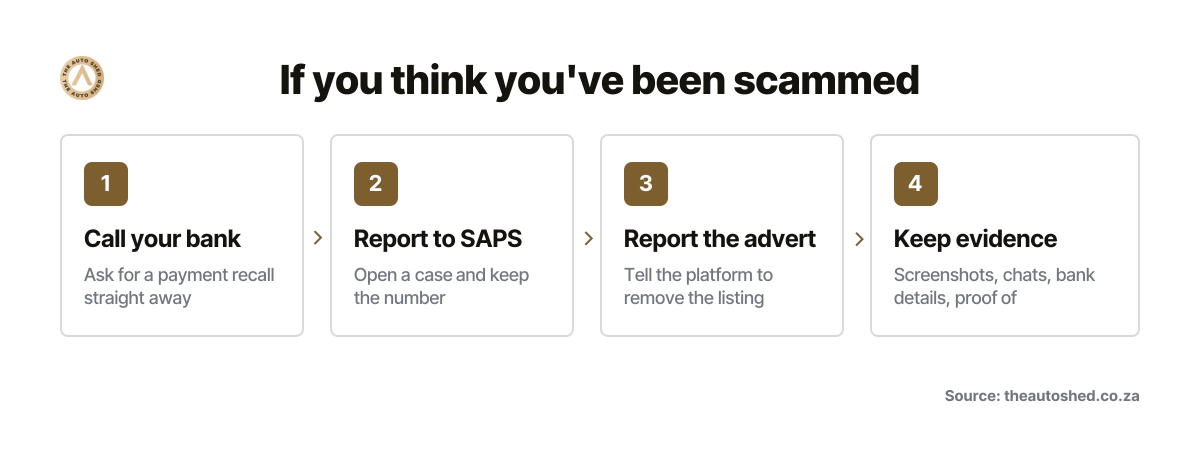
What to Do If You Think You Have Been Scammed
Act within minutes, not days. Speed is the single biggest factor in whether any money can be recovered, and every hour of delay gives the fraudster time to move it.
- Call your bank straight away. Explain what happened, give the transaction details and ask them to attempt a payment recall and to flag the receiving account.
- Report it to SAPS. Open a case and keep the case number, because your bank may ask for it.
- Report the advert or profile to the platform. That can get the listing removed before it catches someone else.
- Keep all evidence. Save screenshots, chat messages, the advert, phone numbers, banking details and proof of payment. Do not delete the conversation.
Can you get your money back? Sometimes, but we cannot promise it. If the funds have already left the receiving account, recovery is much harder, and no bank or police report can guarantee a refund. What it does do is give you the best chance, and it helps stop the next victim.
If you are a seller who has already handed over a car, tell the police at once and give them the buyer's details and the vehicle information.
This is general guidance, not legal advice. If a large sum is involved, speak to your bank and a legal adviser.
Why Buying From a Trusted Dealer Takes Much of the Risk Away
An established dealer has a physical address, a trading history and a reputation that depends on you being happy afterwards. That removes most of the scams above. There is no anonymous seller, no "holding deposit" to a stranger and no pressure to pay before you have seen the car.
At The Autoshed in Centurion, every vehicle is hand-selected and goes through our Autoshed Approved inspection. We keep the vehicle history and paperwork transparent, so you can see what you are buying before you commit. If you are not in Gauteng, we arrange nationwide delivery, so distance does not have to push you towards an unknown seller.
Over 70% of our business comes from repeat customers and referrals. That only happens when people are treated honestly, and it is the best measure of trust we know. For a closer look at the trade-offs, read about buying from a dealer versus a private seller.
Our standard is simple: if a vehicle isn't good enough for our family, it isn't good enough for yours. If you would like a safer, transparent way to buy, browse our Autoshed Approved vehicles. And if you are unsure about a deal you have found elsewhere, contact our team. We are happy to talk it through.
Frequently asked questions
How can I tell if I have been scammed online?
Warning signs after the fact include a seller who stops replying once you have paid, a car that never arrives, or a delivery that suddenly needs extra fees. If the seller's name, bank account and registration papers do not match, treat it as fraud. Contact your bank immediately rather than waiting to see whether the seller comes back.
What are the most common car scams in South Africa?
For buyers, the usual ones are too-good-to-be-true listings with stolen photos, fake deposits and courier fees, cloned dealer pages, and vehicles that are stolen or still under finance. For sellers, they are fake proof of payment, reversed payments, overpayment refunds and upfront fees to be matched with a buyer.
What is a red flag in a car dealership?
Be wary of a dealer with no verifiable physical address, one who asks for a deposit before you can view the car, or one whose bank account is not in the business's name. Reluctance to show papers or let you arrange an independent inspection is also a warning. A good dealer welcomes these checks.
Can I get my money back if I am scammed on a car sale?
Sometimes, but it is not guaranteed. Your best chance is to call your bank at once to attempt a payment recall, then open a SAPS case and report the advert to the platform. The longer you wait, the less likely it is that the money is still in the receiving account.