
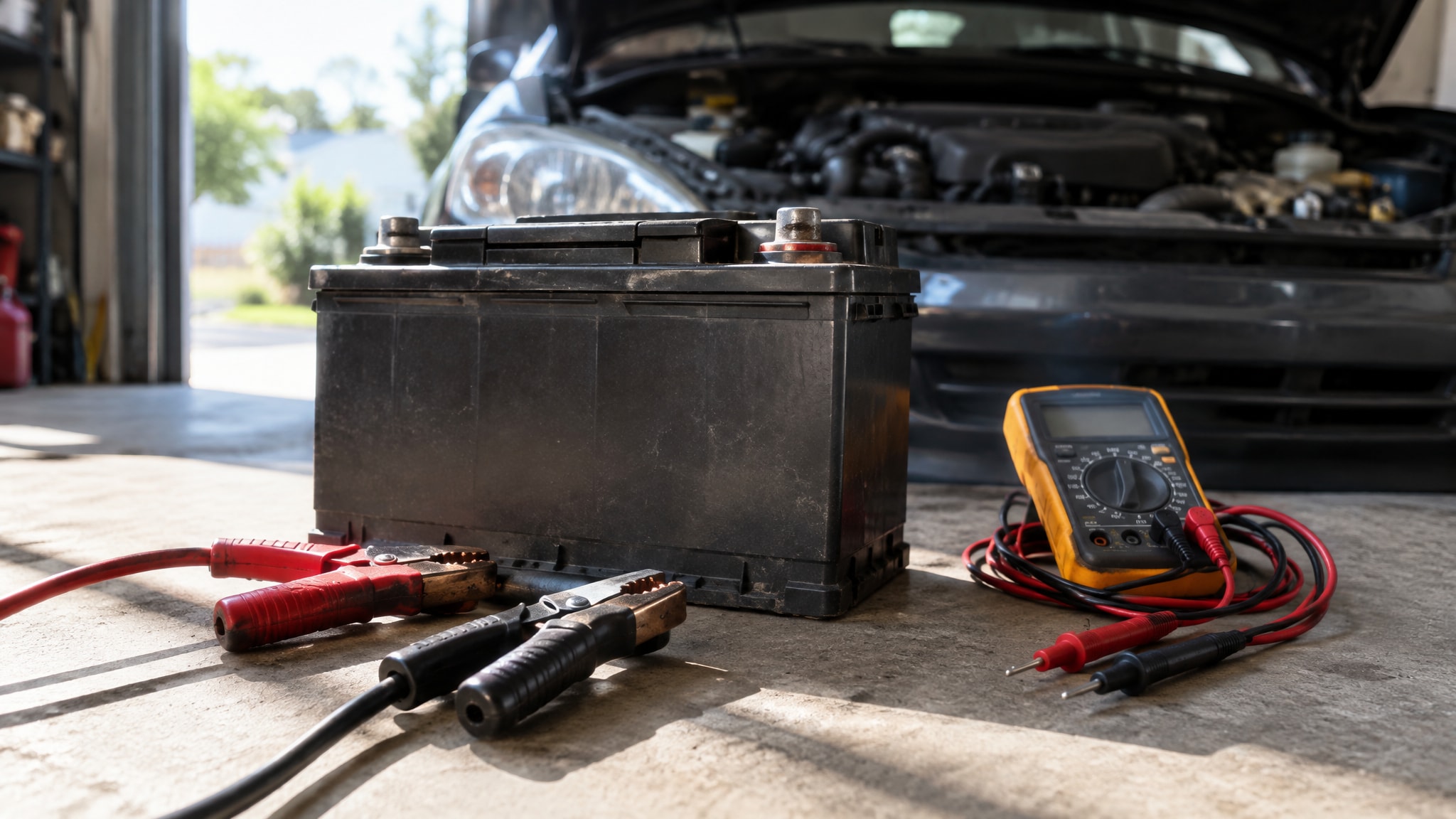
A flat car battery never picks a convenient moment. It waits for the airport car park, the cold Monday morning or the day you're running late for a client. The good news is that a failing battery nearly always gives notice, if you know what to look for.
We've spent 28+ years between us in the motor industry, and batteries are one of the most overlooked parts on any car we inspect. This guide covers how they work, how long they last on South African roads, the warning signs, how to test one safely, and how to choose a replacement.
How a Car Battery Works and What It Actually Does
Your car battery is usually a 12-volt lead-acid unit that stores electrical energy and releases it on demand. The alternator, driven by the engine, recharges it while you drive.
Battery, alternator or starter?
| Battery | Alternator | Starter | |
|---|---|---|---|
| Slow cranking | Likely | – | – |
| Dim lights | Likely | Likely | – |
| Cuts out while driving | – | Likely | – |
| Single click, bright lights | – | – | Likely |
| Warning light while driving | – | Likely | – |
Think of the two as a partnership: the battery starts the day's work, and the alternator keeps it topped up once the engine is running.
Starting, powering electronics and stabilising voltage
The battery does three jobs, and most owners only think about the first.
- Starting: it delivers a short, heavy surge of current to turn the starter motor.
- Powering electronics: with the engine off, it runs the alarm, the central locking memory and the clock. With the engine at idle, it helps carry the load when the alternator can't keep up.
- Stabilising voltage: it smooths out the alternator's output so sensitive modules get a steady supply.
That third job matters more than it used to. A modern executive sedan or premium SUV carries a web of control units, sensors, screens, heated seats and driver aids. Start-stop systems add another strain, because the battery restarts the engine at every traffic light.
A battery that was fine in a simpler car can struggle in one of these, which is why the correct type matters (more on that below).
How Long Does a Car Battery Last in South Africa?
A typical car battery lasts a few years, not a decade. Local conditions and how you use the car can push that figure either way, and so we’d rather explain what shortens or extends battery life than give you one number that suits every car and fits none.
Heat, Highveld conditions and short trips
Heat is the battery's quiet enemy. Gauteng summers speed up the chemical wear inside the cell, and a battery that has been cooked for a few seasons can fail on the first cold winter morning, when it has to work hardest.
Short commutes make it worse. Starting the engine takes a big gulp of charge, and a ten-minute drive through Centurion traffic may not put it all back. Run that pattern for months and the battery sits permanently undercharged, which shortens its life.
Heavy electrical loads add to the burden. Air conditioning, seat heating, a big infotainment system and extra accessories all draw current, and a battery that never gets a full recharge has little in reserve.
Why age and mileage both matter
A battery ages with time and with use, so the odometer only tells half the story. A low-mileage executive sedan used only for short city trips can have a weak battery despite a low reading, which is why we test rather than assume.
The same applies when you're weighing mileage versus age on a used car. A car that has stood for long stretches can have a tired battery just as easily as one that has covered big distances.
Warning Signs Your Car Battery Is Failing
You will usually get several weeks of hints before a battery gives up completely. The trick is to recognise them early and not put them down to a cold morning.
Slow cranking and dashboard warnings
The classic sign is a slow, laboured start. The engine turns over reluctantly, as if it's tired, and it gets worse on cold mornings.
Other common symptoms:
- A battery or charging warning light on the dashboard
- Headlights that dim when you start the engine or idle at a junction
- A start that needs a second or third attempt
- Needing a jump-start more than once
Before you replace anything, work out whether the battery, alternator or starter is actually at fault. They share symptoms, but there are tells:
- Battery: slow cranking, dim lights, and a car that starts fine after a jump or a long charge but struggles again a day or two later.
- Alternator: the car starts, then the warning light comes on, the lights fade while driving, or the engine cuts out mid-journey. A new battery won't cure this, because it will simply drain again.
- Starter: a single click or a grinding noise, but the lights stay bright and the dashboard comes to life normally.
A garage can tell these apart in minutes with the right tester, so it's worth asking before you buy parts.
Electrical glitches in modern vehicles
In newer cars, the first sign is often odd behaviour. The infotainment screen restarts, the start-stop system stops working, driver-assistance warnings flash up for no obvious reason, or windows move slowly.
Many owners chase these as software faults. Low battery voltage is a frequent hidden cause, because control units behave unpredictably when their supply dips. If several unrelated glitches appear together, have the battery tested before you pay for diagnostics on anything else.
Physical signs: corrosion, swelling and leaks
Look at the battery itself. White or blue-green crusty deposits around the terminals mean corrosion, which restricts current flow. A swollen, bulging case usually points to heat damage or overcharging. Any wetness or acid smell around the casing suggests a leak.
Swelling and leaks mean the battery is finished. Don't try to nurse it along.
How to Test and Check Your Car Battery
Safety comes first. Batteries contain acid and can release flammable gas, so wear gloves and eye protection, keep sparks and naked flames away, and switch off the ignition before touching a terminal.
Simple checks you can do at home
Start with your eyes. Check the case for cracks or bulging, and look at the terminals for corrosion. Press gently on the leads to make sure they're tight, because a loose clamp can mimic a dead battery.
If you own a multimeter, you can take a rough voltage reading with the engine off and the car rested for a few hours. A healthy, fully charged battery reads roughly 12.6 volts. A noticeably lower figure suggests it's undercharged or ageing. With the engine running, the reading should rise to somewhere around 13.5 to 14.5 volts, which tells you the alternator is charging.
A voltage check has its limits, though. It shows you the battery's state of charge, not its ability to deliver heavy current, so a battery can read well and still fail when asked to start the car.
When to get a professional load test
A load test applies a controlled demand to the battery and measures how well it holds up, which is what the starter asks of it every morning. It gives the real picture of health, and a workshop can run one quickly.
Book one if the car cranks slowly, if the battery is several years old, or before a long trip or the cold season. Also have one done if the car has been standing for weeks. On a modern vehicle, ask the technician to check the charging system at the same time.
Choosing the Right Replacement Car Battery
The cheapest battery on the shelf is rarely the right one for a premium vehicle. A wrong match can cause starting trouble, electrical faults and early failure, so this is a decision worth a few minutes. If you're weighing up what a car really costs to run each month, remember that the right battery usually works out cheaper than replacing the wrong one twice.
Matching size, type and specification to your vehicle
Your owner's manual states the specification the manufacturer wants. Battery makers and vehicle makers both advise replacing like for like, and that matters most on start-stop cars, which need an AGM or EFB battery.
The key points to match are physical size, terminal layout and position, capacity, and cold-cranking performance. A battery that physically fits but has the terminals on the wrong side, or too little capacity, will cause trouble.
Standard, AGM and start-stop batteries
- Standard (flooded) batteries suit simpler cars without start-stop and with modest electrical demands.
- EFB batteries are an enhanced flooded design, made to handle the repeated restarts of basic start-stop systems.
- AGM batteries cope better with deep discharge and heavy electrical loads, so they're common in cars with start-stop and many electronics.
Fitting a standard battery in a car designed for AGM is a false saving. It may wear out much faster and can upset the charging system. If you're unsure which type your car came with, check the manual or the label on the old battery, or ask a specialist.
Fitting, registration and disposal
Many premium European models need the new battery coded or registered to the car's electronics after fitment. Skip that step and the charging system may keep treating the new battery as an old one, which can shorten its life or trigger warnings.
For that reason, we recommend fitment by a reputable specialist with the right equipment, not a quick roadside swap. This guide is general advice, not a substitute for your manufacturer's instructions on your particular model.
Finally, never throw an old battery in the bin. Lead and acid are hazardous, so hand it to the fitter or a recycling point, as most retailers and workshops will take it back.
Making Your Car Battery Last Longer
Most of what keeps a battery healthy is habit, and none of it is complicated.
- Take a longer drive regularly, ideally well over the usual short hop, so the alternator can fully recharge the battery.
- Switch off lights, air conditioning and chargers before you turn off the engine.
- Keep the terminals clean and tight.
- Park in the shade or a garage in summer, because heat does lasting damage.
- Have it checked before a long road trip or before winter.
A car that sits for weeks needs extra care, because the battery slowly discharges even with everything switched off. If you're leaving a vehicle for a long time, ask a workshop about a maintenance charger. Starting it every so often for a few minutes rarely helps much, since that doesn't replace the charge you used.
There's a limit to all this. Good habits slow the wear, but they can't make an old battery young again, and every battery needs replacing eventually.
Drivers who are curious about electric cars should know their 12-volt battery still matters. We touch on that in our piece on electric vehicles in Gauteng.
Why the Battery Matters When Buying a Used Car
A battery is cheap compared with an engine, but a weak one can hide behind a clean service history and a shiny finish. It can also be the first clue to how a car has been used and stored.
On any used car, ask how old the battery is and whether it has been load-tested recently. A seller who can answer both is usually a seller who looks after cars. For more on spotting problems early, see how to avoid buying a bad used car, and keep an eye on starting behaviour and electrics when you read what to look out for on a test drive.
If a vehicle isn't good enough for our family, it isn't good enough for yours.
How we check batteries on Autoshed Approved vehicles
Battery condition is part of every Autoshed Approved inspection. With 28+ years of combined motor industry experience behind our team, we know that a quick glance isn't enough, so we look at three things:
- The battery itself: its condition, age and whether it shows any swelling or leaks.
- The terminals and leads: corrosion, looseness and signs of poor previous repairs.
- The charging system: whether the car actually recharges the battery properly once running.
Our base in Centurion means summer heat and short commutes are what we see every day, and we know how hard they are on batteries. That's why we check battery health before any vehicle is delivered anywhere in the country.
If you're considering a premium used car, you're welcome to browse our Autoshed Approved vehicles or get in touch for honest advice. There's no pressure, and we're always happy to talk through what you're looking for.
Frequently asked questions
Can a car battery fail without any warning?
Yes, though it's less common than a gradual decline. A battery can fail suddenly after a heatwave or a cold snap if it was already weak. A load test before winter or a long trip is the best way to catch it first.
Can I replace my car battery myself?
On simple cars it's possible if you take care with gloves, eye protection and the order of the terminals. On many premium European models, though, the new battery must be coded or registered to the car's electronics. In that case we recommend a reputable specialist.
Is a jump-start a fix for a flat battery?
No, it only gets you moving. If the battery is old or damaged, it will probably fail again within days. Have it load-tested, and check the alternator as well.
Do electric cars still have a 12-volt battery?
Yes. Electric cars have a high-voltage drive battery, but they also carry a 12-volt battery that runs the electronics and systems. If that smaller battery weakens, the car can show warnings or refuse to start.
Should I ask about the battery when buying a used car?
Yes. Ask how old it is and whether it has been load-tested, since a low odometer reading doesn't guarantee a healthy battery. At Autoshed, battery condition is part of our inspection on every vehicle.