
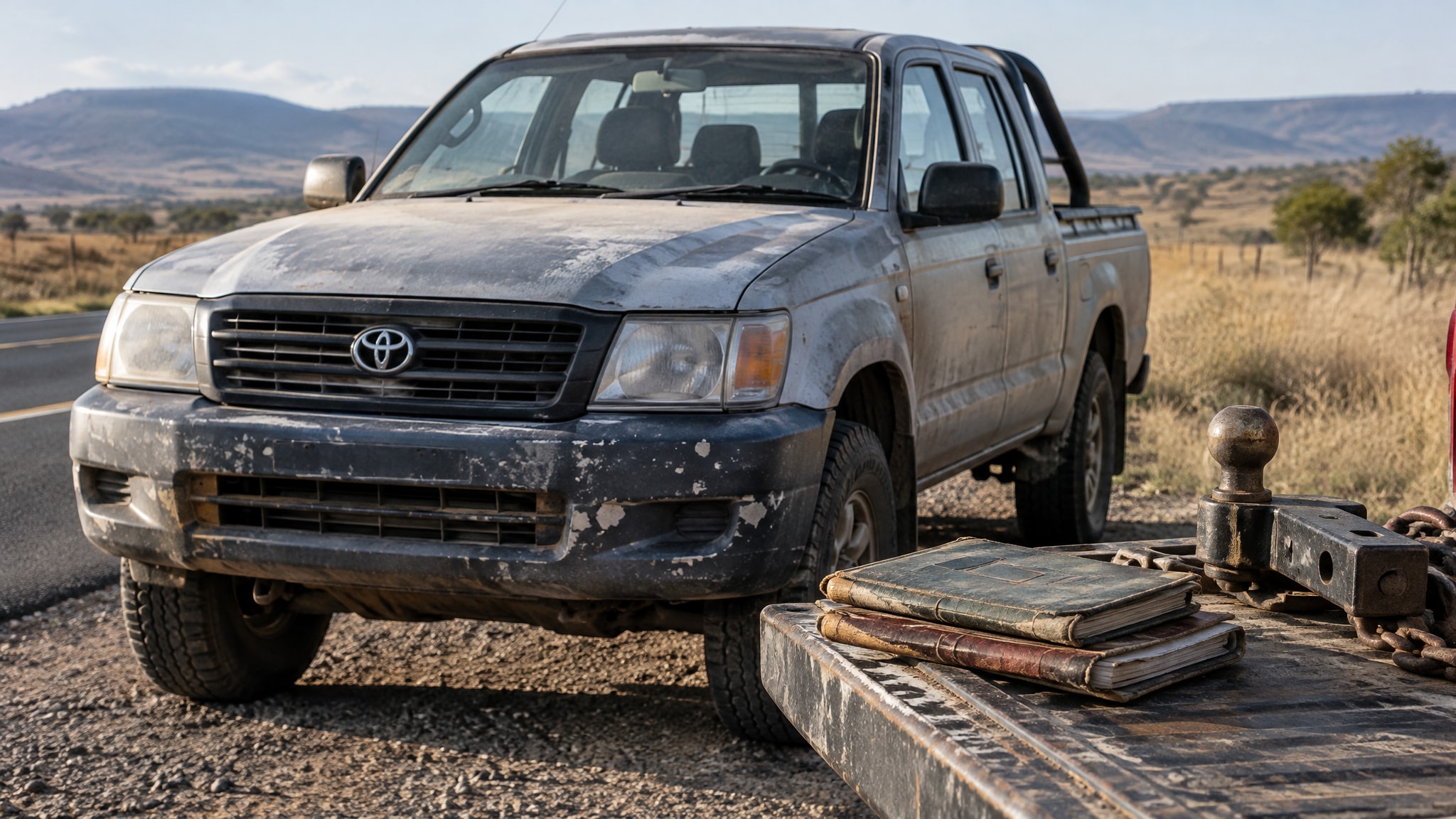
Ask ten South African buyers what makes a used car "high mileage" and you will get ten different answers. A bakkie owner who tows for a living sees 200,000 km very differently from someone commuting between Centurion and Sandton in a sedan.
The odometer matters, but it is never the whole story. Here is how we read used car mileage after 28+ years of combined motor industry experience, and how you can do the same before you sign anything.
The Average KM Per Year in South Africa
Most South African cars cover somewhere between 15,000 and 20,000 km a year. Treat that as a guide, not a fixed figure, because no two drivers use a car the same way.
Distances here shape the number. Cities such as Johannesburg, Pretoria and Cape Town sprawl, so a daily commute can be long even before the weekend starts. Then there are the holiday runs to the coast, the Kruger or the Drakensberg, which can add thousands of kilometres in a single December.
Some owners barely reach 10,000 km because the car is a second vehicle or a weekend car, while sales reps and business owners can pass 30,000 km without trying.
The 15,000 km rule of thumb and where it comes from
The 15,000 km figure is a working average, not a regulation or a manufacturer's promise. It sits at the lower end of the range that many local buyers and dealers use when they size up a car quickly.
Dealers use it because it is easy to apply: multiply by the car's age and you get an expected reading. You can use it too, as long as you remember it only gives you a starting point, and the sections below explain what to check next.
Mileage vs Age: Which Matters More on a Used Car?
Neither wins on its own. Mileage tells you how hard the mechanical parts have worked, while age tells you how long the rubber, seals, fluids and electronics have been exposed to heat, dust and sitting still.
A car that covers high kilometres wears its engine, gearbox, clutch, suspension and brakes. A car that sits for years ages in different ways: hoses harden, seals dry out, brake fluid absorbs moisture and tyres crack even with plenty of tread left.
So the honest answer is that you weigh both, then let the service history break the tie. If you take only one idea from this article, take that one.
When a low-km older car is a warning sign
A ten-year-old car showing 40,000 km looks like a bargain, and sometimes it is. Occasionally it is a car that was driven gently by a careful owner and serviced on schedule.
More often, low use comes with its own problems. Cars that rarely run can develop perished bushes, leaking seals, stiff suspension components and tired batteries. Short trips are hard on an engine too, because it seldom reaches full operating temperature.
There is also a more serious possibility: the reading is wrong. A very low figure on an older car, with nothing on paper to support it, is exactly where we slow down and look harder.
When a high-km newer car is the better buy
A three-year-old car with 90,000 km can be a better purchase than it first appears. If most of those kilometres were motorway driving, which the service records can help confirm, they will have been far gentler than the stop-start variety.
If the car was serviced on time at a franchise dealer or reputable specialist, the engine and gearbox have likely had exactly the care they needed. You are also paying less for the depreciation that hits hardest in the first years.
This is not a licence to ignore wear. A high-km car still needs a proper inspection of the suspension, tyres, brakes and any warranty or service-plan position, because heavy use shows up there first.
How to Judge Used Car Mileage for Your Situation
The arithmetic is easy. The judgement around it is where buyers go wrong, so we split it into three parts: a quick calculation, the type of driving, and the type of vehicle.
A simple km-per-year check
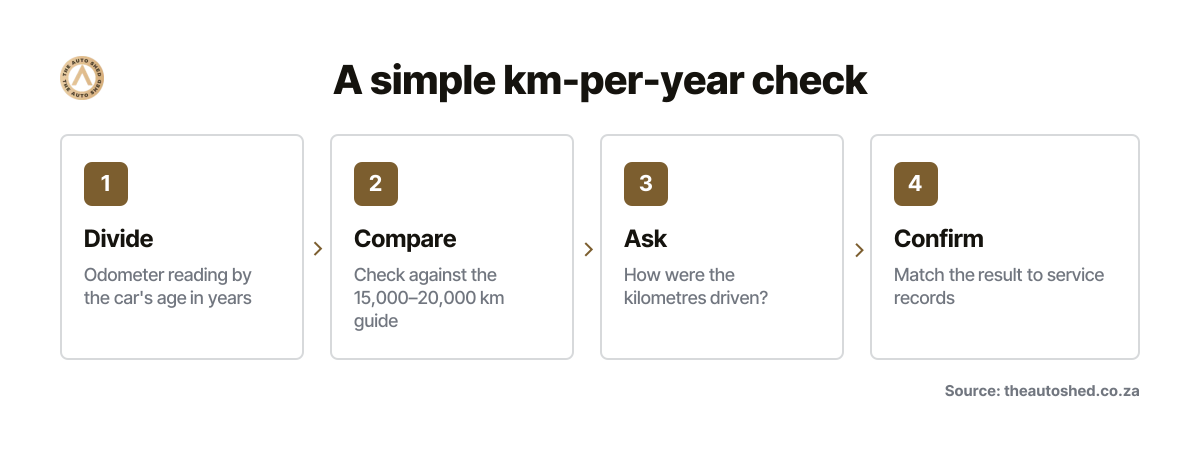
Work through it in this order:
- Divide the odometer reading by the car's age in years.
- Compare the result with the 15,000–20,000 km guide.
- Ask how the kilometres were driven: commuting, towing, long trips or short hops.
- Confirm the answer against service records.
Take a six-year-old SUV showing 90,000 km. That works out at 15,000 km a year, which is right on the guide. A car showing 30,000 km at the same age works out at 5,000 km a year, which is well under it and is worth questioning.
This check cannot tell you how the car was driven, whether it was maintained or whether the reading is genuine. It only tells you whether the number is unusual, so you know where to ask more questions.
Highway kilometres vs city kilometres
An engine at steady speed on the N1 runs warm, at constant load, with little gear shifting or braking. In the city, the same engine idles in traffic, cold-starts every morning and works the clutch, brakes and suspension far harder.
That is why two cars with identical odometer readings can be in very different shape. A 120,000 km car that spent its life commuting on the highway often feels fresher than a 70,000 km car that did school runs and short trips.
You can usually tell by looking at the interior wear, the state of the brakes and what the service records say about the car's usage.
Bakkies, SUVs and luxury cars: different expectations
Diesel bakkies and many SUVs are built to cover high kilometres, so a figure that would worry you on a compact hatchback can be perfectly normal on a double-cab. Even so, a bakkie that has towed heavy loads or worked on rough roads needs a close look at its drivetrain and suspension.
Premium and performance cars are different. A Mercedes-Benz or similar executive car can run happily well past 150,000 km, but only when servicing has been proven and on time. Skipped services, missed fluid changes and unexplained gaps cost far more to put right on these cars.
Our advice is simple. The more complex and expensive the car, the more the paperwork matters, and the less the raw odometer figure should drive your decision.
Why Service History Outweighs the Odometer
A well-documented 150,000 km car often beats an undocumented 80,000 km one. The first has a record of what has been done to it. The second asks you to take someone's word for it.
Here is an illustrative example, not real data. Picture two six-year-old SUVs: one with 90,000 km and a full dealer service history, the other with 45,000 km and no records at all. We would favour the first without hesitation, because every kilometre on it is accounted for and the half-as-many kilometres on the second prove nothing.
Mileage is only one input. It sits alongside service history, tyre and pedal wear, and a proper drive, which is why we wrote about what to look out for on a test drive.
What a full service history should show
When you look through the records, you want to see:
- A stamped service book with dates and odometer readings at each service.
- Invoices from the dealer or workshop that match the stamps.
- Evidence of major jobs, such as timing belts, clutches, brake work and transmission services.
- Readings that rise steadily over time, with no long gaps and no sudden drops.
Be wary of a book with every stamp in the same ink, or of readings that do not line up with the invoices. And a missing history does not automatically mean a bad car, but it does mean you are buying on trust alone, which is not a position we like for our customers.
We believe in showing a vehicle's history openly. If the paperwork is thin, we say so.
Spotting Clocked or Unreliable Odometer Readings
Odometer tampering, or "clocking", is a real risk in the South African used market. Someone winds the reading back to make a car look younger and more valuable than it is. Odometers have long been targets for this, and digital displays are no exception.
You cannot rely on the dashboard figure alone. If a price looks too good for the age and condition, that gap deserves an explanation before you go any further, and our guide on how to avoid buying a bad used car covers the wider red flags.
Cross-checks: wear, records and history reports
Start with the car itself. Physical wear is hard to fake, so it should agree with the claimed distance.
- Pedals: worn rubber or shiny bare metal on a car showing 30,000 km is a red flag.
- Driver's seat: a sagging bolster or cracked leather does not belong on a low-km car.
- Steering wheel and gear knob: polished, shiny or peeling surfaces suggest heavy use.
- Tyres and brakes: a worn set on a supposedly low-use car needs an explanation.
Next, check the paper trail. Compare the odometer with the readings in the service book, on invoices and in any history report. Each of those should tell the same story.
Finally, confirm the legal side. You should also check a car for stolen or finance owing status before any money changes hands, because a car with a doubtful odometer often has other problems too.
What Mileage Means for Price, Finance and Trade-In Value
Mileage affects value in bands rather than in a smooth line. Cars well below the expected average tend to command a premium, those around the guide sit in the middle, and those well above it are discounted, with the gap widening as the kilometres climb.
Service history shifts those bands. A high-km car with a complete record can hold its value far better than a low-km car with gaps, so the paperwork you keep is worth money when you sell.
Finance and warranties add another layer. Some lenders and warranty providers apply limits on a vehicle's age or kilometres, so a car that looks fine to you may fall outside a particular product. Ask about this early, and read up on how vehicle finance approval works so that nothing catches you out.
The same logic applies when you trade in. Kilometres over the odds, missing records and neglected servicing are among the things that hurt your trade-in value, so what you do while you own the car matters as much as the number on the dash.
How We Approach Mileage at The Auto Shed
If a vehicle isn't good enough for our family, it isn't good enough for yours. That is why every car we sell goes through the Auto Shed Approved inspection, which checks condition and history rather than leaning on the odometer alone.
We show history openly, so the mileage you see is checked against the records, not just quoted. Over 70% of our business comes from repeat customers and referrals, and we would rather earn that trust slowly than win a sale by glossing over a gap in the records.
Our inspection follows the same principles as our certified pre-owned inspection checklist, and we arrange financing, trade-ins, buy-back and nationwide delivery from our base in Centurion.
When you are ready, browse our approved pre-owned vehicles. If a particular car's mileage or history raises a question, ask us. We will walk you through it with no pressure.
Frequently asked questions
Is 15,000 km a year high or low for a used car?
It is around the middle to lower end of the usual South African guide of 15,000–20,000 km a year, so it is not high. Under 10,000 km a year is low and worth a closer look at the records, while well over 20,000 km suggests heavy use, which matters most on premium cars.
How many kilometres is too many on a used car?
There is no single cut-off. It depends on the vehicle type, how the kilometres were driven and whether servicing is documented. A diesel bakkie with a full history can be a sound buy at a reading that would worry you on a complex luxury car with gaps in its records.
Can I be sure a used car's odometer reading is genuine?
Not from the dashboard alone. Compare the reading with service book stamps, invoices and any history report, and check that pedal, seat and steering wheel wear match the claimed distance. If the story does not add up, walk away or ask the seller to explain.
Is a low-mileage older car always worth a premium?
No. Low kilometres on an old car can mean perished rubber, tired seals and ageing fluids, or even a wound-back odometer. Pay a premium only when the records and a proper inspection support the reading.