
If you owe more on your car than it would fetch today, you are in negative equity. It is far more common than most owners admit, and it is no reflection on your judgement.
It is a numbers problem, and numbers can be managed once you can see them clearly. Below, we explain how a negative equity car comes about, how to check your own position, and which ways out are worth taking. This is general guidance, not personal financial advice.
What Negative Equity on a Car Actually Means
Almost everyone with vehicle finance owes something on it, and that alone is perfectly healthy. Negative equity begins only when your settlement figure is higher than the car's market value.
The settlement figure is what your finance provider needs today to close the account completely. Market value is what a buyer would realistically pay for the car, and the two numbers move independently of each other.
An outstanding loan is simply a debt. A car in negative equity is a debt that you could not clear by selling the vehicle, because the sale would leave a gap.
A simple worked example
Take a typical case. Your finance provider quotes a settlement figure of R320,000, and a dealer offers R290,000 for the car on trade-in.
The difference is R30,000. That is your shortfall, and it has to come from somewhere if you want to end the agreement and move on.
A dealer's trade-in offer will sit below the retail price you see on a listing, because the dealer still has to prepare the car and resell it. When you are selling to a dealer, the trade-in figure is the one that counts.
What Causes a Car to Fall Into Negative Equity
Negative equity almost never comes from one bad decision. It builds when the car's value drops faster than your balance, and several ordinary choices can widen that gap at the same time.
Depreciation outpacing your repayments
Cars lose value fastest in the first years of ownership. In those same years, a large share of each instalment goes towards interest rather than the capital you owe, so the balance falls slowly while the value falls quickly.
The higher the rate, the wider the gap. If you want to see why, read up on how interest rates affect what you owe over the life of an agreement.
Long terms, small or no deposits and balloon payments
A long term lowers the monthly instalment, but it also slows the pace at which the balance shrinks. You can spend years owing more than the car is worth simply because the repayments are spread so thinly.
A small or zero deposit means you start underwater on day one. Part of the price you financed was never backed by the car's value.
A balloon payment works in a similar way, because it keeps a big chunk of the balance outstanding until the end of the term. Add a high interest rate and the effect compounds.
Rolled-over debt is the other common cause. If you carried a shortfall from a previous car into a new agreement, you began the new loan already owing more than the vehicle was worth.
How to Check Whether You're in Negative Equity
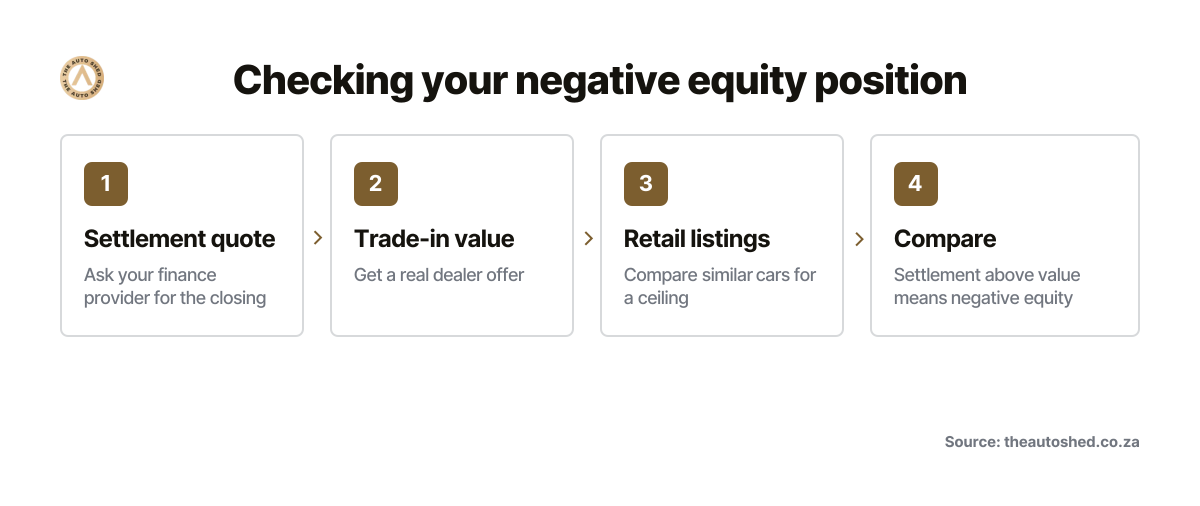
You do not need to guess. Two numbers answer the question, and you can get both within a day or two.
- Request an early settlement quote. Ask your finance provider for the figure needed to close the account on a specific date.
- Get a trade-in valuation. A real offer from a dealer tells you what the car is worth to a buyer today.
- Check live retail listings. Look at similar cars of the same year, mileage and condition to see the realistic ceiling.
- Compare. If the settlement figure is higher than the trade-in value, you are in negative equity by the difference.
Get your settlement figure and a real market valuation
A settlement figure is not the remaining instalments added up. Your provider's quote reflects the account as it stands on a given date, and it may include fees or exclude interest not yet earned, so ask for the breakdown rather than doing the sum yourself.
For the valuation side, our family's 28+ years of combined motor industry experience means we value trade-ins daily. We can explain how settlement figures compare with market value in a transparent, no-pressure way.
Condition affects the result more than most owners expect. Review the things that quietly reduce your trade-in value before you ask for quotes, so there are no surprises.
Your Options When You Owe More Than the Car Is Worth
There is no single right answer here, because the best route depends on how big the shortfall is and how much you still need the car. Some options cost less in the long run, and others only feel easier today.
Keep the car and pay it down
If the car still suits you and the instalments are manageable, this is often the cheapest route. Every payment narrows the gap, and the car's value declines more slowly as it ages, so the two numbers eventually meet.
You can speed things up with extra payments, which the National Credit Act entitles you to make. Ask your provider to confirm they’re applied to the capital balance.
It does not suit you if the car no longer fits your life or the instalment is a strain. Waiting only helps when you can comfortably keep paying.
Trading in a car with negative equity
Yes, you can trade in a car with negative equity. The dealer settles your finance with your provider, deducts the trade-in value, and the shortfall is left for you to deal with.
You have two choices for that shortfall. You can pay it in cash, or you can roll it into the new agreement.
Rolling it in is convenient, but the new loan then starts above the value of the next car as well. You are financing the old car and the new one together, which is how one shortfall turns into a recurring one.
If the shortfall is large, a cheaper replacement can break the cycle. Our guide to trading down without regrets covers how to do that sensibly.
Selling privately or to a dealer and settling the shortfall
A private sale may fetch a higher price than a trade-in, which shrinks the gap. However, your provider must be paid in full before the car can change hands cleanly, so you will need the shortfall in cash at the point of sale.
The same applies when you sell to a dealer outright. Either way, you cover the difference between the sale price and the settlement figure yourself.
This is the cleanest exit if you can afford it, because the debt ends completely. If you cannot, it is not realistic.
Refinancing: when it helps and when it only delays the problem
Yes, you can sometimes refinance a car in negative equity, but approval is not guaranteed. Lenders consider the value of the vehicle alongside your income and credit record, and how vehicle finance approval works is worth understanding before you apply.
Refinancing helps when it secures a lower interest rate without stretching the term. The same balance then costs you less to carry, and your repayments actually reduce it faster.
It only delays the problem when the saving comes from a longer term. A smaller instalment feels like relief, but you pay more interest overall and stay underwater for longer.
Refinancing does not remove the shortfall. It changes the terms on which you owe it.
How to Avoid Negative Equity on Your Next Car
Prevention is mostly arithmetic. You want the balance to fall at least as fast as the car's value, and three levers control that: the deposit, the term and the vehicle itself.
Choose the right vehicle, deposit and term
Put down as much deposit as you can sensibly manage. A meaningful deposit means you do not start underwater, and it lowers the amount on which interest is charged.
Choose the shortest term whose instalment you can live with comfortably. Be wary of balloon structures that keep the balance high while the car ages.
Pick a vehicle with a track record of keeping its value. It helps to know which cars hold their value before you commit, and mileage and condition matter as much as the badge.
Buying a quality pre-owned car after the steepest depreciation has passed is one of the simplest protections. The first owner has already absorbed the sharpest drop, so your balance and the car's value stay much closer together. A demo car sits somewhere between new and used, so compare its price with a comparable pre-owned example before you decide.
Every vehicle we sell goes through our "Autoshed Approved" inspection process. If a vehicle isn't good enough for our family, it isn't good enough for yours.
No choice here removes depreciation entirely. It only keeps the gap small enough to manage.
Negative Equity and Insurance, Write-Offs and Hidden Traps
Insurance adds one more risk. If the car is stolen or written off, the insurer pays out on the vehicle's value, and that payout can fall short of what you still owe the finance provider.
You would then owe the difference on a car you no longer have. Ask your insurer or broker about shortfall cover (sometimes called credit shortfall insurance), which is designed for this gap, and read the terms before you rely on it.
The same caution applies when you buy used. A car can still have finance owing on it, so check for finance owing before you buy and never hand over money until that is confirmed.
Talk to Us Before You Trade or Refinance
If you suspect you owe more than your car is worth, the most useful step is to find out for certain. We can get an honest valuation for your vehicle and explain your finance options, with no pressure to buy anything.
Once you have a settlement figure and a real trade-in value, you can decide with the facts in front of you. Whether you keep the car, sell it or move into something else, we will talk it through with you the way we would for family.
Frequently asked questions
“Can I trade in my car if it has negative equity?
Yes. The dealer settles your finance with your provider and deducts the trade-in value, and you cover the shortfall. You can pay it in cash or roll it into the new agreement, though rolling it in means the new loan starts above the next car's value.
Can you refinance a car that is in negative equity?
Sometimes, but approval depends on your income, credit record and the vehicle's value. It helps if you secure a lower rate without lengthening the term. If the instalment drops only because the term is longer, you pay more interest and stay underwater for longer.
What causes a car to have negative equity?
The car loses value faster than your balance falls. Small or no deposits, long terms, high interest, balloon payments and shortfalls carried over from a previous car all widen the gap.
Is my settlement figure the same as my remaining instalments?
No. The settlement figure is what your provider needs to close the account on a given date, and it can include fees or leave out interest not yet earned. Ask your provider for a written early settlement quote and its breakdown.
What happens if my car is stolen or written off while I'm in negative equity?
The insurer pays out on the car's value, which may be less than your settlement figure. You would owe the difference on a car you no longer have. Ask your insurer or broker about cover options for that gap.