
Most drivers think of tyres as a running cost. Insurers think of them as evidence. When a claim lands on a desk, the condition of the rubber on the road is one of the first things an assessor looks at.
We have spent 28+ years combined in the motor industry, and we have seen good claims get complicated over a tyre that nobody had checked in months. This guide explains how a worn tyres insurance claim is usually assessed in South Africa, what your cover does and does not include, and how to keep your paperwork in order. It is general guidance, not legal advice, and your own policy wording always has the final say.
Can Worn Tyres Affect Your Insurance Claim?
Yes. An insurer can reduce or decline a claim if worn tyres contributed to the loss, because your policy assumes the car is roadworthy and properly maintained.
That does not mean every bald tyre ends a claim. What matters is whether the tyre condition played a part in what happened, and that question of cause runs through everything below.
We are not insurers, and we cannot tell you how your particular insurer will rule. What we can do is tell you what we see across hundreds of vehicles, so you walk into a claim prepared rather than surprised.
How Insurers Treat Worn Tyres When You Claim
Roadworthiness and the duty to maintain your vehicle
Every comprehensive policy includes a condition that you will keep the vehicle in a safe, roadworthy condition. Tyres are the only part of the car touching the road, so they sit at the top of any roadworthiness check.
If you let that slide, an insurer may argue you breached the policy's maintenance expectations, and a breach gives them grounds to push back on the payout.
Your maintenance records are your best defence here. Receipts for new tyres, alignment and rotation show an insurer that you looked after the car, and in our experience a tidy file settles more arguments than any amount of explaining after the fact.
When tyre condition becomes the cause of the accident
Insurers look for a link between the tyre and the loss. Typical examples are a skid on a wet road, a blowout at speed, or a car that failed to stop in time because the tread could not clear water.
Picture a typical case. A driver slides on a wet highway on badly worn tyres and hits the car ahead. The insurer asks whether the tyres contributed to the collision, and an assessor's photographs of smooth tread make that argument far easier to run.
A worn tyre that played no part in the loss may not defeat a claim at all. If a driver is hit from behind while parked, for instance, the tread depth is unlikely to matter.
Wording varies from insurer to insurer, however, so read the exclusions in your own policy rather than relying on what a friend was told. Disputes of this kind regularly reach the National Financial Ombud Scheme, and they tend to turn on the same thing: whether the insurer could show the tyre condition contributed to the loss.
What Counts as a Worn or Bald Tyre in South Africa
Tread depth and the legal minimum
Tread is what channels water out from under the tyre. As it wears down, grip on wet roads falls away, and braking distances grow.
The legal minimum tread depth in South Africa is 1mm, set by the National Road Traffic Regulations. That’s a legal floor, not a safe target, and a tyre that is only just legal is rarely a tyre you want in a downpour
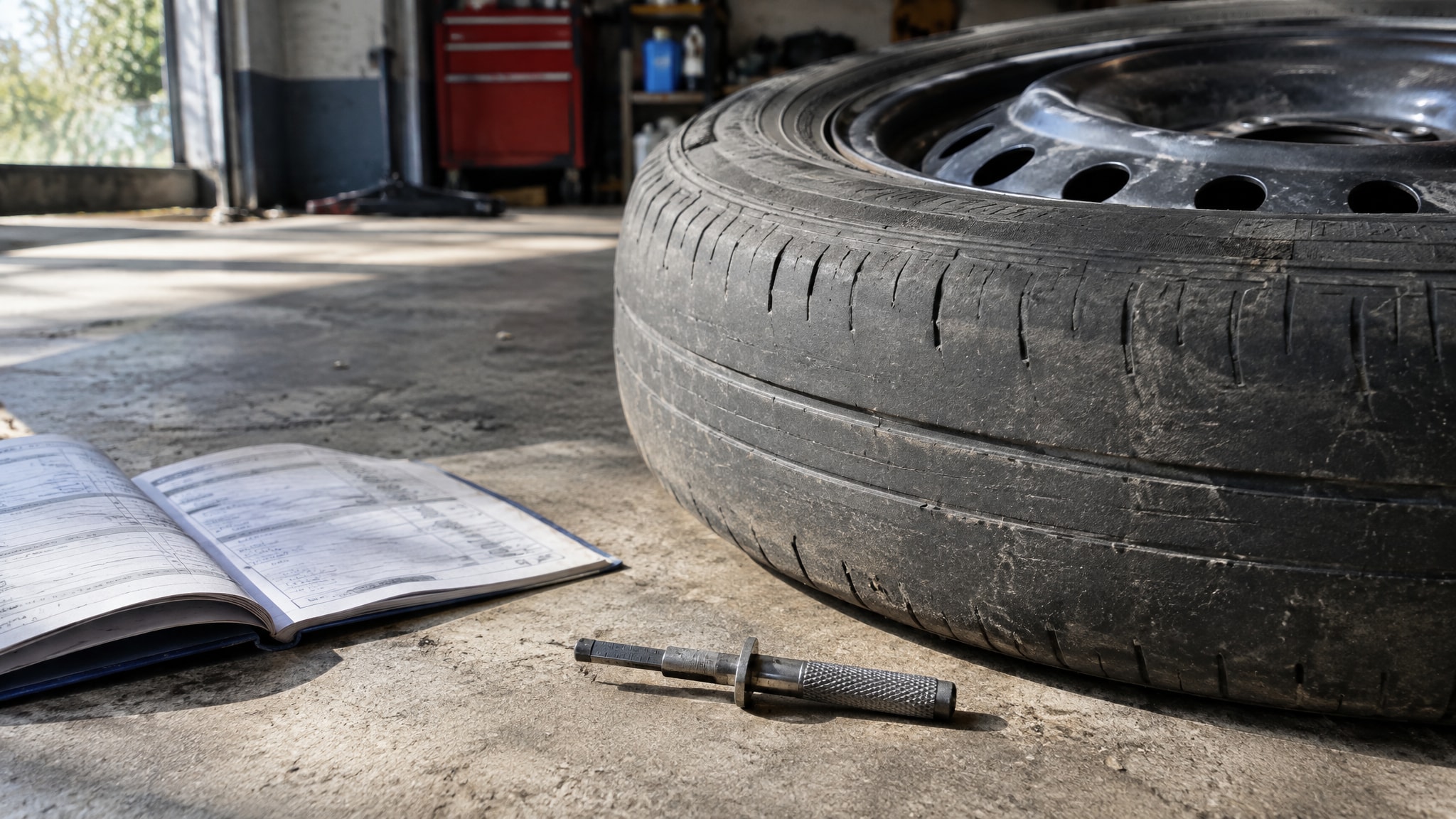
Every tyre carries tread wear indicators: small raised bars in the grooves. Once the tread is level with them, the tyre has reached the end of its life. You can also use a simple tread depth gauge, which costs very little and takes seconds to read.
Other signs: cracks, bulges, uneven wear and age
Tread depth is only half the picture, because a tyre with plenty of tread can still be unsafe. Here is what we look for:
- Cracks in the sidewall or between the tread blocks, which show the rubber is ageing and drying out.
- Bulges or bubbles, which mean the internal structure has been damaged, often by a pothole or kerb.
- Uneven wear, such as a bald inner edge, which usually points to alignment or suspension problems.
- Age, because tyres that sit unused or in strong sun harden over time, even when the tread looks fine.
You can check the age of a tyre from the date code moulded into the sidewall. If you cannot read it, ask a fitment centre to do it for you.
Tyre Damage Versus Wear and Tear: What Is Actually Covered
The distinction insurers draw is simple. Sudden, accidental damage is an insured event. Gradual deterioration through normal use is a maintenance matter, and it belongs to you.
Why standard motor cover excludes gradual wear
Standard comprehensive cover pays for loss caused by an event, such as a collision, theft or hail. Tyres that wear out from kilometres on the road are not an event, so the cost of replacing them is excluded.
If you have been assuming your policy will pay for new tyres when the old ones are finished, it will not. Neither will a service plan, and the difference between the two is worth understanding, so see our note on service plan versus maintenance plan for how tyres are usually treated as a separate budget line.
Punctures, kerb damage and add-on tyre and rim cover
A puncture, a sidewall cut from debris or a rim bent on a kerb is sudden damage, and this is where optional tyre and rim cover comes in. It is usually an add-on, not part of standard cover.
Add-on cover is typically applied per wheel, and it normally comes with conditions. The most common is a requirement that the tyre still has a certain amount of tread left when the damage happens. A tyre that was already close to bald may not qualify.
This cover is not a substitute for maintenance. It helps when something unexpected happens to a tyre in good condition, but it will not pay out for tyres you let run down, so read the conditions before you assume you are protected.
How to Make a Claim When Tyres Are Involved
How soon should you tell your insurer? As soon as it is safe to do so, ideally the same day. Your policy sets the exact timeframe for reporting, and late notification can hand an insurer a reason to query the claim, so check that deadline today instead of after an accident.
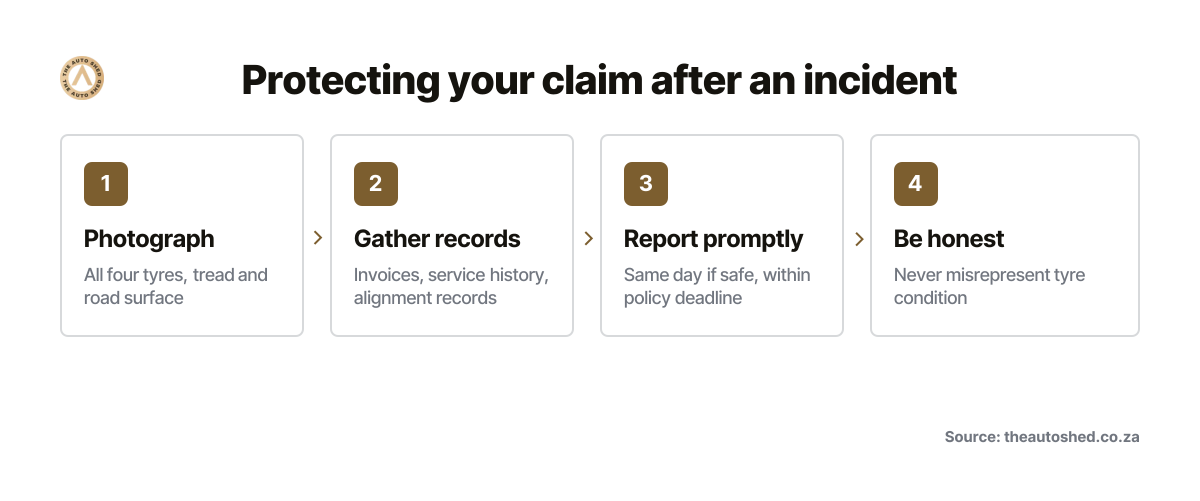
Document everything straight after the incident
Once everyone is safe, start collecting evidence. A few minutes at the scene can save weeks of back-and-forth.
- Photograph all four tyres, close up, and the road surface around the vehicle.
- Photograph the tread against a coin or gauge so the depth is visible.
- Note the tyre brand, size and approximate fitment date if you know it.
- Keep your invoices, service history and any alignment or rotation records together.
Where the incident requires a police report, get one and keep the reference number with your documents. Our usual advice is to build a folder on your phone now, before you need it.
If your car has also suffered other damage, for example from storms, our guide to hail season claims in Gauteng covers a similar documentation routine, and our windscreen replacement safety guide does the same for glass.
Be honest with your insurer and assessor
Never misrepresent the state of your tyres. Do not swap them before the assessor arrives, and do not describe them as better than they were.
An assessor can usually see the truth in seconds, and a false statement turns a negotiable dispute into an allegation of fraud. That is a far worse position than a reduced payout.
If your tyres were worn, say so, and explain why you believe they did not contribute to the loss. Honesty keeps your credibility intact, and it keeps your relationship with the insurer intact too.
Part-Worn Tyres, Replacements and Staying Claim-Ready
Part-worn tyres are a risk worth taking seriously. An assessor may query them because their history is unknown: they may have been repaired, stored badly or run under-inflated before you bought them. If a part-worn tyre fails and caused the accident, you will struggle to show it was a sound choice.
If you do buy them, keep the invoice, check the age code and have them fitted by a reputable centre. We would rather you bought new tyres on a car you rely on every day.
How long a tyre lasts depends on how and where you drive. A bakkie that carries heavy loads, a performance car with soft compounds and a SUV on rough roads will each wear tyres at very different rates. Most tyres last for tens of thousands of kilometres, but the real answer for your car comes from the manufacturer's guidance and your own measurements. Age counts too, because rubber hardens even on a car that barely moves.
A monthly routine keeps you claim-ready:
- Check pressures when the tyres are cold, including the spare.
- Read the tread depth in several places across each tyre.
- Look for cracks, bulges, nails and uneven wear.
- Note the date and result in your phone, with a photo.
Ten minutes a month builds the very record an insurer wants to see. It also helps you plan ahead, and our breakdown of what a car really costs to run each month shows where tyre replacement fits in a realistic budget.
Buying a Used Car With Tyres You Can Trust
Tyre condition tells you a lot about how a used car was treated. Four matching tyres with even wear suggest an owner who cared. Mismatched brands, uneven wear or cracked sidewalls suggest the opposite, and they can signal an alignment or suspension issue underneath.
On a test drive, listen for humming, feel for vibration through the steering wheel and notice whether the car pulls to one side. We cover this in more detail in what to look out for on a test drive. If the tyres need replacing soon, factor that cost into your offer, because a new set on a premium SUV or bakkie is a real expense.
Our Auto Shed Approved inspection checks tyre condition on every vehicle before it reaches the showroom. Our team looks at tread depth across the full width of each tyre, inspects the sidewalls for cracks, cuts and bulges, and checks for uneven wear that could point to deeper mechanical problems. It is one part of a wider inspection, and it is not a promise that tyres will last forever, since wear continues once you drive away.
Our approach is simple: if a vehicle isn't good enough for our family, it isn't good enough for yours. A car that arrives with sound, well-matched tyres starts its life with you on the right footing, with nothing for an assessor to question.
If you would like to see what that looks like in practice, browse our Autoshed Approved vehicles or contact our team in Centurion. We deliver nationwide, and we are always happy to talk you through any car's condition before you commit.
Frequently asked questions
Is a tyre covered under car insurance?
Only against sudden, accidental damage such as a puncture, a sidewall cut or kerb damage, and often only if you have added tyre and rim cover. Standard comprehensive cover does not pay for tyres that have simply worn out. Check your policy for per-wheel limits and any remaining-tread conditions.
How many kilometres do part-worn tyres last?
There is no reliable figure, because their history is unknown. A part-worn tyre starts with less tread, and it may carry hidden repairs or age damage. Check the age code, measure the tread yourself and keep the invoice in case an assessor asks.
How long after an accident can you claim on car insurance?
Your policy sets the deadline, so read the notification clause. As a rule, report the incident as soon as it is safe, ideally the same day. Late reporting gives the insurer a reason to query the claim, even when the accident was not your fault.
Will my insurer reject my claim if my tyres were only slightly worn?
Not automatically. Insurers look at whether the tyre condition contributed to the loss. Slightly worn tyres that played no part are unlikely to defeat a claim, but tyres close to the legal limit in wet-weather crash are harder to defend.